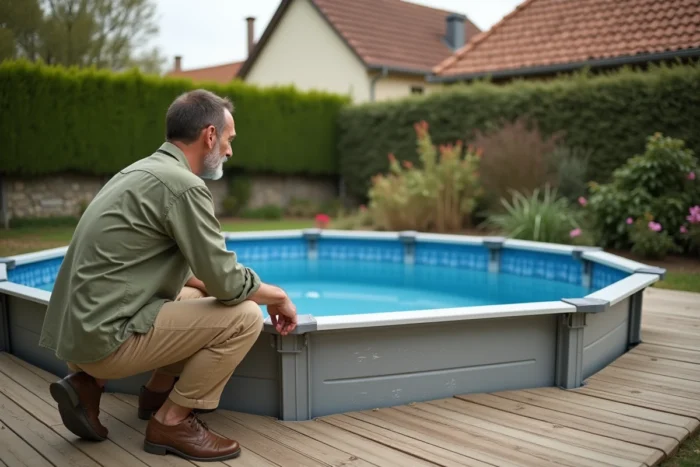
The taxation of swimming pools is not limited to a surface area threshold. Several criteria determine whether a private pool generates an increase in property tax, housing tax on secondary residences, or development tax. Surface area, ground attachment, duration of installation, connections: each parameter weighs in the analysis of the tax administration.
Taxable or non-taxable pool: comparative table of tax criteria
The tax classification of a pool depends on the combination of several technical characteristics. Here is a synthetic summary of the most common situations.
| Type of pool | Surface area | Ground attachment | Duration of installation | Taxable (property tax) |
|---|---|---|---|---|
| In-ground concrete or shell | Any surface | Permanent (excavation, slab) | All year round | Yes |
| Semi-in-ground with coping | Any surface | Permanent | All year round | Yes |
| Above-ground rigid, removable | Greater than 10 m² | None (set up) | Less than 3 months/year | No |
| Above-ground rigid, removable | Less than 10 m² | None (set up) | Less than 3 months/year | No |
| Above-ground inflatable or tubular | Any surface | None | Less than 3 months/year | No |
| Mini-in-ground pool | Less than 10 m² | Permanent (excavation) | All year round | Yes |
The last line of the table illustrates a common trap. Many owners believe that an in-ground pool of less than 10 m² is exempt from property tax. This is not the case: a ground-attached pool remains taxable regardless of its surface area. The determining criterion for the administration is the notion of a fixed construction that cannot be moved without being destroyed, as the site impots.gouv.fr reminds us.
To fully understand the criteria for a non-taxable pool, one must cross-reference the surface area of the pool with its method of attachment and its duration on the property.
Ground attachment and connections: the real tax criterion for the pool
The surface area of 10 m² is often presented as the boundary between taxation and exemption. This reading is incomplete. The tax administration first assesses whether the pool constitutes a fixed construction that cannot be moved without destruction.
In practical terms, several technical elements transform a pool into a taxable construction:
- Excavation or earthworks, even light ones, that anchor the pool in the ground.
- The presence of coping, a surrounding terrace, or a concrete slab attached to the pool.
- A connection to the water network (filling, draining) and electricity (filtration, heating), indicating a permanent use.
The material of the pool (concrete, wood, steel, polyester shell) is not decisive in itself. A semi-in-ground wooden pool with coping and connections will be treated for tax purposes like an in-ground concrete pool. In contrast, an above-ground steel pool placed on grass, without any anchoring or permanent connections, remains outside the scope of property tax.
This point explains why the material does not determine taxation; it is the method of installation that matters.
Duration of installation and above-ground pool: the three-month rule
An above-ground pool, even a large one, can remain non-taxable provided it adheres to a time limit. The pool must be installed for less than three months per year to avoid being reclassified as a permanent construction.
This rule applies to inflatable, tubular, or removable metal structure pools. It does not concern in-ground or semi-in-ground pools, which are by nature permanent installations.
Tax reclassification of an above-ground pool
If an above-ground pool remains in place all year, the administration may consider it as a built dependency of the dwelling. The reclassification then leads to a reassessment of the cadastral rental value, which is the basis for calculating property tax and, if applicable, housing tax on secondary residences.
The risk is real. The administration now uses aerial detection tools (satellite images, artificial intelligence) to spot unreported pools. Several departments have already intensified these checks, particularly in Gironde.
Development tax and urban planning declaration for a pool
The development tax is distinct from property tax. It applies only once, at the time of construction, for any pool requiring a prior declaration of works or a building permit.
The prior declaration is mandatory for in-ground or semi-in-ground pools with a surface area between 10 m² and 100 m², without a cover or with a cover less than 1.80 m in height. Beyond 100 m², a building permit is required. Above-ground pools installed for less than three months per year do not require any urban planning declaration.
Frequent confusion between urban planning and taxation
The absence of an urban planning declaration does not mean the absence of a tax obligation. An above-ground pool of less than 10 m² does not need a prior declaration of works. It is also not subject to the development tax. But if it remains installed all year and is permanently connected, it can still be included in the calculation of the rental value.
The two logics (urban planning and taxation) operate on criteria that partially overlap, without being identical. Not needing a permit does not guarantee exemption from property tax.
Temporary exemption from property tax after construction
Owners who build a taxable pool benefit from a temporary exemption from property tax for the two years following the completion of the work. This exemption is conditioned upon the submission of a declaration (form 6704 IL) to the property tax office within 90 days after the end of the construction.
After this period, the exemption is lost. The pool will be included in the calculation of property tax from the first year without the owner having been able to benefit from the two years of exemption. This administrative point, often overlooked, represents a significant saving in the first years of pool use.
Building a truly non-taxable pool requires meeting three conditions: a removable pool without destruction works, no permanent anchoring to the ground, and a duration of installation of less than three months per year. As soon as one of these criteria is missing, the pool falls within the tax scope, regardless of its size or material.