
Working at McDonald’s remains one of the first professional experiences for thousands of young people each year in France. Behind the image of an easy student job to get, this position in fast food comes with concrete realities that recruitment sheets do not always detail. Salary, training, work pace, career progression: here’s what you need to know before signing a contract with McDonald’s.
Compensation at McDonald’s: what the payslip really says
The salary of a crew member at McDonald’s starts at the minimum wage. For a student job on a fixed-term contract or part-time, the net monthly amount remains modest. Where the salary scale becomes clearer is on the management side.
Since 2025, a beginner manager earns between 2,000 and 2,200 euros gross per month, which is about 1,600 to 1,750 euros net. After three years of experience, this amount rises to 2,300-2,600 euros gross. These levels are regulated by the collective agreement for fast food.
In addition to this fixed salary, there are annual bonuses that can reach up to 1,000 euros, linked to the restaurant’s performance. This is often overlooked when comparing the benefits of working at McDonald’s with other fast-food chains.
Indirect benefits also weigh in: heavily discounted meals during shifts, health insurance, provided uniforms. For a student, the almost free meal at each shift represents a real saving on the monthly budget.
McDonald’s Internal Training: a springboard or wasted time
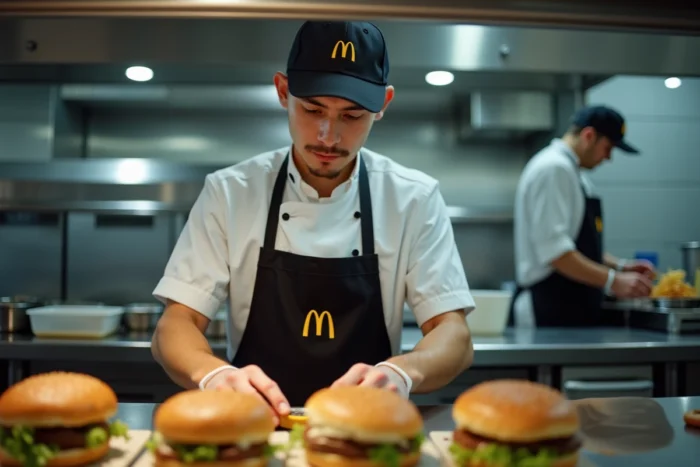
McDonald’s has structured a training pathway that goes well beyond a simple welcome briefing. Each new crew member follows an in-restaurant program, with progressive modules on preparation, cash handling, customer service, and food hygiene.
Have you noticed that some former McDonald’s employees mention this experience as formative on their CVs? This is not trivial. The internal training programs are certified, meaning they have recognized value beyond the brand.
The pathway to the manager position follows a stair-step logic:
- Versatile crew member, where one learns every position in the restaurant (kitchen, counter, drive-thru, dining area)
- Trainer, responsible for guiding new arrivals on the ground
- Team leader, responsible for a service with about fifteen people to supervise
- Operational manager, who manages stocks, schedules, and restaurant performance
This system allows someone who started as a student crew member to progress to a management position in a few years. The testimony of a former manager summarizes the trajectory well: arrived for a seasonal job, left three and a half years later as an operational manager.
The limits of this training
Progression remains contingent on availability. A student on a 15-hour-per-week contract will have little chance of accessing responsibilities. Internal advancement favors those who accept full-time and irregular hours.
Work hours and conditions in fast food
This is the point that comes up most often in employee reviews, and rightly so. Hours at McDonald’s are rarely compatible with a typical social life. Work in the evening, on weekends, and on holidays: the restaurant almost never closes.
The range of hours is wide. Some crew members juggle late closures followed by early openings, with sometimes short rest periods between shifts. For a student, the flexibility of schedules is an asset. For someone on a full-time permanent contract, this same flexibility can become a constraint.
The physical demands of the job are often underestimated. Standing for six to eight hours, running between the kitchen and the counter, managing the lunch or dinner rush: working at McDonald’s challenges both the body and concentration. Several employees report covering the equivalent of ten kilometers per shift.
The pressure from customers and management
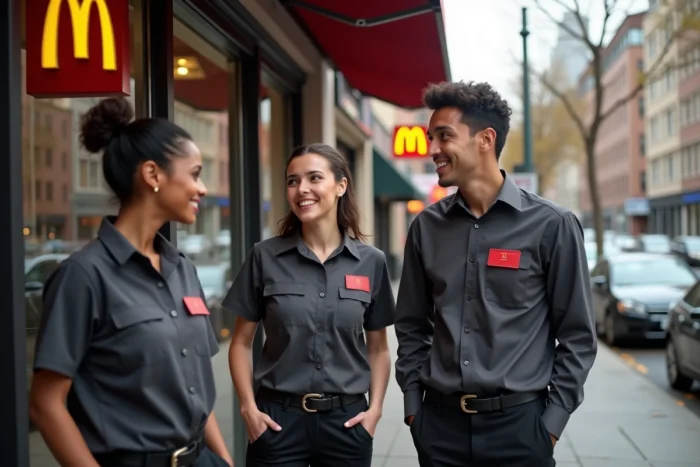
Reviews on Indeed show a mixed reality. Some describe a “fantastic” work atmosphere with “great” management. Others mention “unpleasant” managers and a lack of recognition from franchisees.
This disparity is explained by the franchise model. Each McDonald’s restaurant is managed by an independent franchisee, with its own management culture. The experience varies significantly from one restaurant to another, even within the same city.
Student contract at McDonald’s: what to check before signing
The student fixed-term contract remains the most common contract to enter McDonald’s. A few points deserve particular attention before committing.
- The weekly hour volume: a 10-hour contract offers little income but preserves study time, while a 24-hour contract quickly becomes difficult to reconcile with a busy schedule
- The distribution of shifts: ask if the schedule is fixed or variable, and if night shifts are included in the contract
- The possibilities for adjustment during exams: some restaurants accept to temporarily reduce hours, others do not
The student job at McDonald’s works best when expectations are clear on both sides. Those who find satisfaction are generally those who negotiated a realistic hour volume from the start.
A job at McDonald’s is neither the trap that some describe nor the miraculous springboard touted by recruitment brochures. It is a physically demanding job, properly compensated for management, and formative for those willing to invest in it. The quality of the experience largely depends on the restaurant, the franchisee, and what you are looking for: a temporary supplemental income or a first step towards team management.