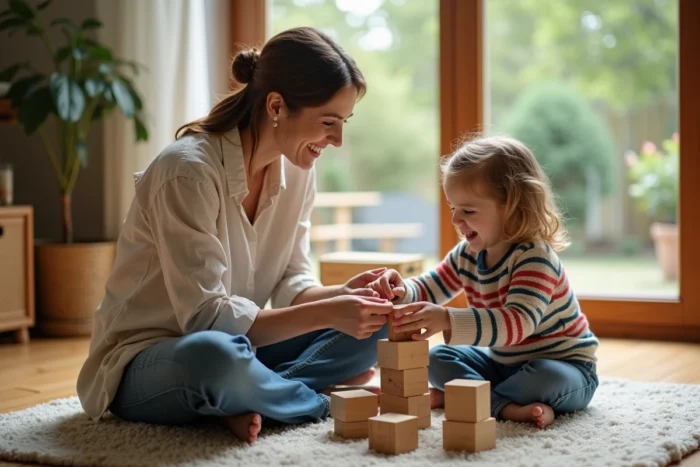
A child who spills their glass at the table, another who refuses to get dressed in the morning: these micro-situations of daily life are often underestimated learning opportunities. A child’s development is not built during exceptional moments, but in the repetition of simple gestures, adjusted words, and predictable rituals. Supporting your child daily is primarily about providing a framework where they can explore, make mistakes, and try again.
Language and communication: the underutilized lever for child development
Have you ever noticed that a child asked an open question sometimes takes several seconds to respond? This latency is not a problem. It is a sign that their brain is organizing its ideas.
The guidelines from the Government of Quebec on the holistic development of children place communication among the major factors of well-being. Their recommendations are concrete: talk often with the child, give them time to express themselves, ask open questions, play with words and sounds, tell stories every day.
In practice, this translates into simple habits. Instead of asking “Did you have a good day?”, try “What made you laugh today?”. The first question invites a yes or no answer. The second requires the child to dig into their memory, choose a memory, and find the right words to tell it. Open questions develop both vocabulary and self-confidence.
Telling a story at night is not just for putting them to sleep. It is a moment of physical and linguistic closeness that reinforces emotional security. You will also find additional ideas by browsing the child sections on Maman du Net, which address these topics from different practical angles.
Child-led play: relinquishing control to better support
“Child-led play” is a concept increasingly recommended by early childhood professionals in North America. The principle is simple: for a defined period, it is the child who decides the game, the rules, the pace. The parent follows, observes, comments on what they see without directing.
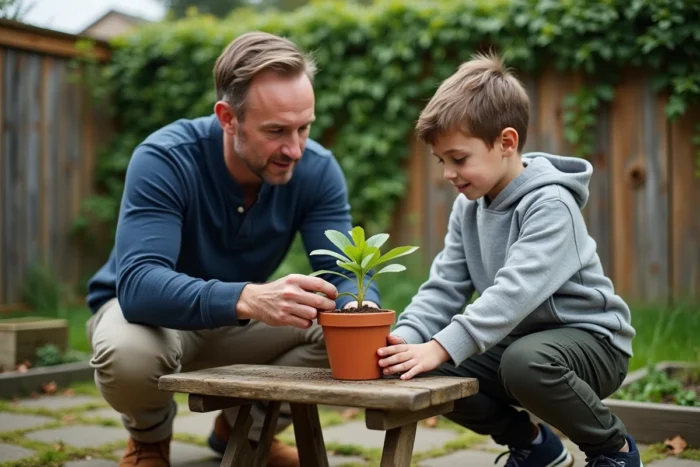
Specifically, if your child is sorting blocks by color, you can say “I see you are putting all the red ones together” instead of “What if you made a tower?”. Describing rather than directing reinforces the sense of competence.
This type of play acts as a tool for emotional regulation. The child who controls their play environment learns to manage frustration (when the tower falls) and pride (when it stands). They also develop a bond with the present parent, without performance pressure.
How much time to dedicate
No need to block off an hour. Fifteen to twenty minutes of child-led play, with an adult fully available (phone put away, no multitasking), is enough to observe an effect on behavior. Regularity matters more than duration.
Daily routines: sleep, physical activity, and screens
European health authorities have been reminding since 2023 that the psychological well-being of children is strongly correlated with three pillars: daily physical activity, sufficient sleep, and strict limitation of screen time. The often-cited benchmark is at least sixty minutes of physical activity per day.
Have you noticed that a child who has run outside in the morning is calmer in the afternoon? This is not a coincidence. Movement releases bodily tensions and promotes concentration for the learning that follows.
Structuring without rigidifying
A routine does not mean a military schedule. The goal is predictability: the child knows what comes after the bath, after the meal, before bedtime. This predictability reduces anxiety and conflicts.
- Set a stable bedtime, even on weekends, with a maximum variation of half an hour. The child’s body adjusts better to a regular rhythm.
- Establish clear rules about screens: not during meals, not in the bedroom, and a limited time slot appropriate for their age. Explicit media rules reduce daily negotiations.
- Incorporate movement into transitions: walk to school, dance while tidying up, race to the car. Physical activity does not need to be formal.

Encouraging autonomy without confusing it with independence
Autonomy does not mean letting the child fend for themselves. It means giving them age-appropriate choices so they can develop a sense of personal efficacy.
For example: a four-year-old does not choose their entire menu, but they can decide between two vegetables. An eight-year-old does not manage their schedule, but they can organize the order of their homework. The framework is set by the adult, while the micro-decisions belong to the child.
What autonomy produces in the long term
A child accustomed to making daily choices gradually learns to take responsibility for the consequences of their decisions. If they choose not to wear their coat and feel cold, the experience teaches them more than a repeated verbal reminder. Autonomy is built through the accumulation of small decisions, not through grand speeches.
- Offer two options instead of giving an order: “Do you want to tidy up your toys before or after snack time?” works better than “Clean your room”.
- Accept mistakes without dramatizing: a spilled glass, a poorly tied shoelace, a failed drawing are normal steps. The parent’s reaction conditions how the child perceives failure.
- Value the process rather than the result: say “You searched for a long time before finding it” instead of “Well done, it’s perfect”. Recognizing effort builds lasting motivation.
Ultimately, daily development comes down to a few simple things: talking with your child rather than at them, letting them lead the play from time to time, maintaining a predictable framework, and entrusting them with age-appropriate choices. These repeated gestures, day after day, create a solid foundation on which they can rely well beyond childhood.