Buying a drill, a pruning shear, or a paint roller without a method often leads to accumulating underused equipment at the back of a garage. The market encourages impulsive buying, with promotions on giant sets and seasonal new products. Retailers multiply their references, but the question remains the same: how to build a coherent set of tools that covers both regular DIY tasks, decor projects, and garden maintenance, without blowing the budget or cluttering the workshop.
Prioritize your purchases before choosing a tool
A Phillips screwdriver is used every week, while a circular saw might be used twice a year. The actual frequency of use of a tool matters more than its presence on a generic list.
A more reliable approach is to classify purchases into three levels: essential, useful in the medium term, accessories. The first level includes what is needed for small recurring tasks (fixing, screwing, light cutting, measuring). The second covers occasional projects like painting a room or installing shelves. The third concerns specialized tools, to be purchased only when a specific project justifies it.
This prioritization allows for spreading expenses over several months. Rather than investing in a set of several hundred pieces, half of which will never be used, it is better to target references that correspond to actual projects. To explore equipment on Brico Déco Jardin, this tiered logic helps filter relevant categories without getting sidetracked.

Multi-tool set or individual purchase: how the format changes things
Pre-assembled tool sets and cases are experiencing a resurgence of interest. Le Parisien highlights that some Makita sets are marketed as including all the essentials, with an aggressive quality-price ratio. The trend is moving towards pooling and standardizing basic kits.
The set has a clear advantage: it avoids building your toolkit piece by piece, reduces the risk of forgetting a complementary tool, and generally costs less than the sum of the tools bought separately. However, it imposes a fixed selection. If three tools out of ten do not correspond to any of your projects, the savings become questionable.
When the set makes sense
For a first DIY toolkit, a well-composed set (drill-driver, bit set, tape measure, level, screwdriver, pliers) covers most small household tasks. It is the most rational format when starting from scratch.
When individual purchases prevail
Once you have a basic toolkit, targeted purchases take precedence. A high-quality hand saw or a forged pruning shear for the garden justifies an individual investment. Buying a specific tool for an identified use lasts longer than a generic equivalent from a set.
Garden tools and decor materials: often overlooked criteria
Outdoor maintenance and decor projects represent a comparable share of domestic equipment purchases. They deserve the same selection criteria as traditional DIY tools.
For the garden, the choice of a tool depends as much on the area to be maintained as on the nature of the soil. An anvil pruning shear is suitable for dry wood, while a bypass shear is for green stems. Confusing the two types accelerates blade wear and damages plants. For hedge trimming, blade length and the weight of the device matter more than the raw power displayed on the packaging.
- Pruning shear: check the type of cut (anvil or bypass) according to the targeted plant, and the presence of an ergonomic spring to limit fatigue
- Spade and fork: prefer a handle made of fiberglass or hardwood, more resistant to clay soils than a softwood handle
- Hose: choose a diameter suitable for the pressure of the domestic network; a hose that is too wide loses useful pressure
- Gardening gloves: distinguish thorn-resistant models (reinforced leather, long cuff) from planting gloves (flexible, tactile) to avoid working with the wrong level of protection

Paint and wallpaper: the materials that make a difference
In interior decoration, the quality of the result depends less on the chosen paint than on the application tools. A low-quality roller leaves marks, and an overly wide edging brush prevents precision in corners.
A good drip-free roller and a suitably sized edging brush avoid most visible defects. For wallpaper, the pasting table and smoothing roller are the two tools that separate a clean installation from a sloppy one. Buying them rather than improvising with a kitchen table saves considerable time.
Maintenance and storage: what prolongs the lifespan of tools
A well-maintained tool remains functional for years. A tool stored loosely in a damp box rusts within months. The difference in longevity between these two scenarios is considerable, yet storage remains the neglected aspect of buying guides.
- Clean cutting blades (pruning shear, shears, saw) after each use to avoid corrosion and the transmission of diseases between plants
- Store power tools in their original case, battery removed, in a dry place
- Oil the metal parts of hand tools once or twice per season
- Hang long-handled garden tools vertically to avoid handle deformation on the ground
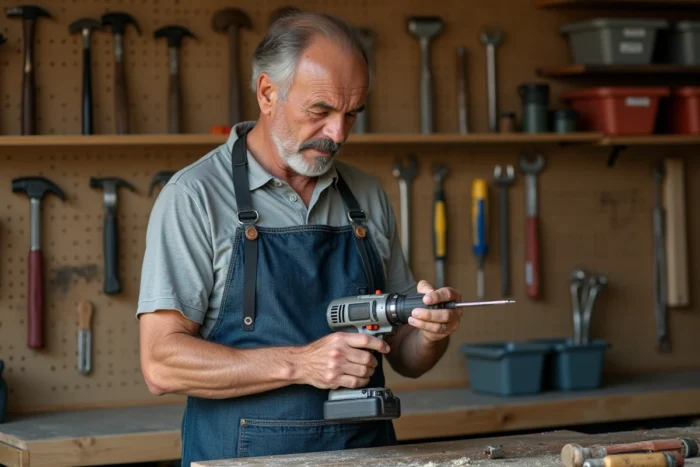
Vertical storage on a pegboard remains the most compact solution for a modest-sized home workshop. It allows you to see all your equipment at a glance and immediately spot a missing tool.
Building a coherent set of DIY, decor, and garden tools does not happen in a single trip to the store. The most reliable method remains to start from concrete projects, buy by priority tier, and devote as much attention to storage as to the initial selection. The time spent sharpening and properly storing a pruning shear pays off over years of use without replacement.