The Norwegian fjords are not visited like a European capital. Distances can be misleading, the roads are winding, and a journey that seems short on the map can easily take twice as long as expected. Before choosing an itinerary, it’s essential to understand how logistics work on-site, as this determines the quality of the stay.
Think in terms of a base region rather than a list of fjords
You spotted the Geirangerfjord, the Nærøyfjord, and the Hardangerfjord on a map? They seem close. In reality, traveling from one to another involves mountain passes, ferries, and sometimes detours of several hours.
The right approach is to choose a base region and radiate from there. Bergen, for example, provides access to the Hardangerfjord and the Sognefjord without multiplying long transfers. From this city, you can reach Flåm by combining train and boat, which opens up the Nærøyfjord without needing a car.
This reasoning avoids the classic trap of a marathon road trip, where you spend more time driving than enjoying the scenery. When preparing the fjords of Norway to discover, this logic of local connections changes the game.
For a first trip, focusing on a single main fjord remains the most coherent choice. You save time, reduce fatigue, and see more in depth.

Car-free itinerary around Bergen and Flåm
Traveling without a car in Norway is not a constraint; it’s a whole new way of discovering. The Bergen-Flåm-Nærøyfjord axis works remarkably well by combining three modes of transport.
The Bergen-Voss-Myrdal train
The railway line connecting Bergen to Myrdal traverses high plateaus, lakes, and birch forests. The journey itself is a stage of the trip, not just a simple transfer.
From Myrdal, the Flåm line descends to the fjord in about twenty minutes, with a spectacular elevation drop. This section is often cited as one of the most beautiful railway lines in Europe.
The cruise on the Nærøyfjord
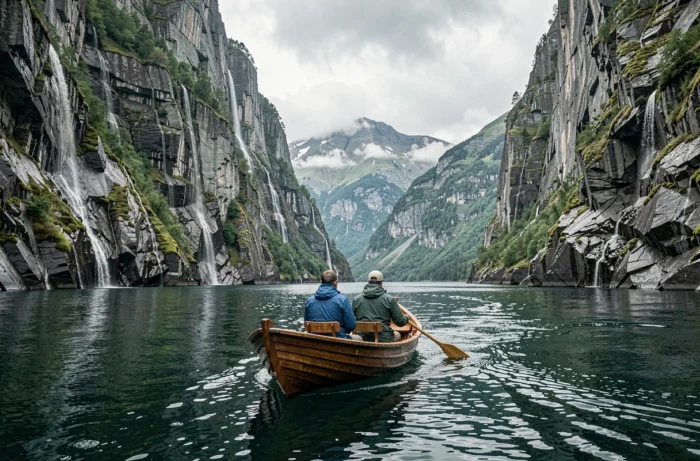
From Flåm, boat shuttles travel the Nærøyfjord, a narrow arm framed by vertical rock walls. The trip lasts about two hours and allows you to observe waterfalls, isolated farms clinging to the slopes, and deep green water.
This itinerary works in a loop over two or three days, without the need for a vehicle. It is particularly suitable for travelers who prefer slowness over mileage.
- Bergen as the starting and ending point, with its varied accommodations and historic Bryggen district
- The scenic train to Myrdal, then the descent to Flåm via the mountain line
- The crossing of the Nærøyfjord by boat, with a possible return by bus to Bergen or continuation to Gudvangen
When to visit the fjords of Norway: the shoulder season
Peak summer, between late June and mid-August, sees the majority of visitors. Accommodations are fully booked, ferries are crowded, and prices rise sharply.
Spring and early autumn offer a more balanced compromise. In May-June, the melting snow feeds powerful waterfalls that transform the landscapes. In September, autumn colors dress the slopes, and visitor numbers drop significantly.
Why does this choice of season change the experience so much? Because the fjords are not just a backdrop; they are living spaces. Water, light, and vegetation vary considerably from month to month. A Geirangerfjord in May, with its waterfalls swollen by the melt, is nothing like the same fjord in July under a blazing sun.
However, the shoulder season requires vigilance. Some mountain roads remain closed late into spring. Checking the status of passes and ferries before each leg is essential, especially if the itinerary passes through high-altitude areas.
Reservations and safety margins: what gets in the way in practice
The fjord region of Norway does not function like a destination where you can easily improvise during the high season. Accommodations near the fjords are few, often small in capacity, and fill up quickly.
- Book accommodations several months in advance for the June-August period, especially in Flåm, Geiranger, and the villages of the Hardangerfjord
- Allow at least an hour margin between two connections (ferry, bus, train), as delays due to weather or boarding are common
- In winter, anticipate road and pass closures, which can change an itinerary overnight
This logistical rigor may seem restrictive. In reality, it is part of the experience. A well-prepared trip to the fjords leaves room for contemplation. An improvised trip in the height of summer risks turning into a race against availability.
The Geirangerfjord illustrates this reality well. This fjord attracts a huge number of visitors, including cruise ships. Going there early in the morning or late in the day, outside peak times, allows you to find the tranquility that these landscapes are known for.
The Norwegian fjords reward those who are willing to slow down. Fewer fjords visited, more time spent on-site, an itinerary designed around local connections: this is the recipe for a stay that lives up to its promises.