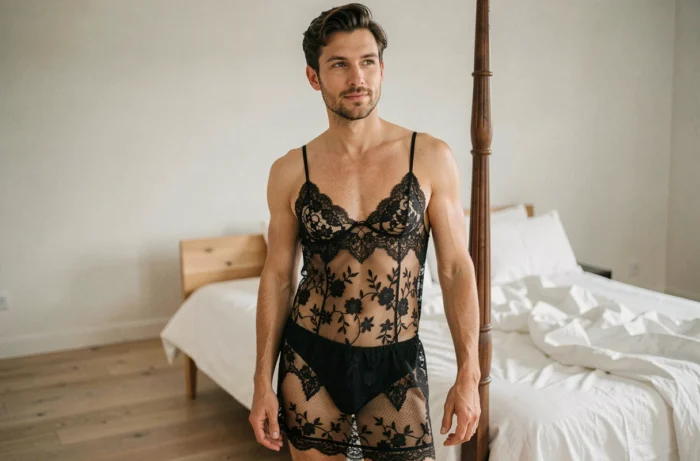
The men’s lace nightgown is not just a simple transfer from the women’s wardrobe. It is a technical piece whose cut, choice of lace, and finishes meet specific morphological and textile constraints. Here, we detail the points that separate a well-designed product from an uncomfortable gadget.
Textile construction of a lace nightgown adapted to the male morphology
The male torso features broader shoulders, a less fitted bust, and a more developed rib cage. A nightgown simply resized from a women’s pattern poses two problems: excessive tension on the straps and deformation of the lace pattern at the sternum.
The best-designed pieces use a central panel made of elastic mesh that absorbs measurement discrepancies, while the lace is reserved for areas where it experiences less mechanical stress (hem, neckline, back). This distribution preserves the pattern without compromising freedom of movement.
The lace itself varies considerably. Rigid Leavers lace, which is noble in women’s lingerie, proves to be poorly suited for daily male wear: it marks the skin on a chest without a bra to distribute the pressure. We recommend elastic laces made from nylon and elastane, which offer bidirectional stretch and reduce friction.
The weight of the lace also plays a role. A fabric that is too thin deforms after a few washes, while a fabric that is too heavy negates the desired lightness effect for nighttime. The sweet spot lies in a lace that is dense enough to maintain its shape while remaining breathable.
Nocturnal comfort and breathability: what men’s lace must guarantee
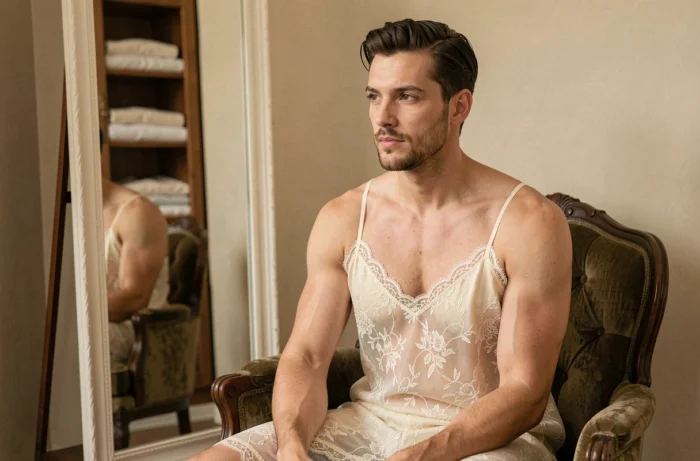
Wearing the men’s lace nightgown daily or for sleeping involves solving a thermal equation. Pure synthetic lace retains heat and moisture, especially in the back and torso areas, where male sweating is more pronounced.
The most advanced constructions combine lace on the surface and partial lining in modal or combed cotton in areas of prolonged contact. Modal, a cellulosic fiber, wicks moisture significantly better than polyester while maintaining a silky touch compatible with the aesthetic of the piece.
- The chest lining in modal or cotton limits the adherence of the lace to the skin during sleep and reduces irritation.
- Flatlock seams at the armholes prevent marks and friction, a point rarely checked on entry-level products.
- The scalloped lace hem without tight elastic at the thighs ensures free circulation, unlike elasticated finishes that ride up during the night.
A poorly lined lace nightwear loses all interest after a few hours. Real comfort in wear remains the least documented criterion in product sheets, yet it is the primary reason for returns.
Care for men’s lace: mistakes that shorten lifespan
Lace is a fragile material, regardless of the context. On a nightgown worn at night, it suffers micro-snags due to the movements of the sleeper and friction with the sheets.
Machine washing without a mesh bag destroys lace in just a few cycles. Using a closed mesh laundry bag with fine mesh is the first precaution. The program should be set to cold or low temperature, without spinning beyond a gentle cycle.
Tumble drying should be systematically avoided. Heat deforms the elastic threads integrated into the lace and causes uneven shrinkage of the pattern. Laying flat to dry on a towel preserves the fabric’s structure.
Another overlooked point: fabric softeners. They leave a film on synthetic fibers that reduces breathability and accelerates yellowing of light-colored laces. Washing with mild soap, without bleaching agents, significantly prolongs color retention.
Replacement frequency
Even with rigorous care, a regularly worn lace nightgown shows signs of wear (pulled threads, loss of elasticity, flattened patterns) more quickly than a nightwear made of jersey or satin. Planning for two pieces in rotation is a pragmatic approach to avoid stressing the same lace for several consecutive nights.
Men’s lace nightgown: selection criteria for a thoughtful purchase
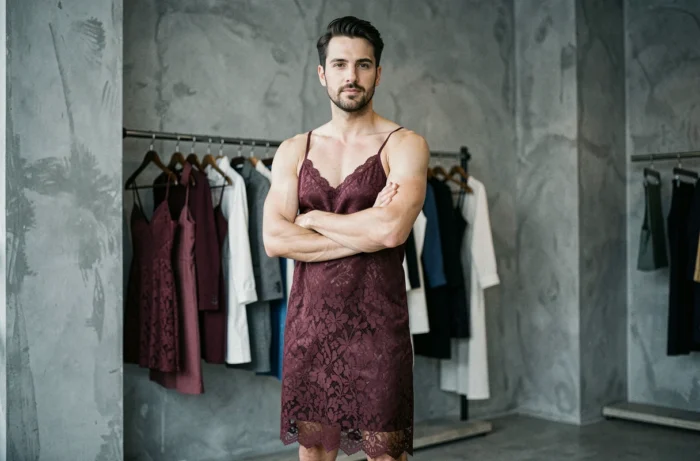
The market remains poorly structured. Between fancy products sold on marketplaces and designer pieces, the quality gap is considerable. We observe that the following criteria effectively filter options.
- Detailed textile composition: a product that does not display the exact percentage of each fiber (nylon, elastane, modal, cotton) does not deserve attention. The absence of this information usually indicates low textile quality.
- Gendered or fitted cut: check that the pattern is designed for a male torso, not simply enlarged. Indicators include the shoulder width listed in the size guide and the presence of an intermediate size beyond XL.
- Visible finishes: adjustable straps (not just elastic), rolled or scalloped hems, flat inner seams. These details separate a functional product from a decorative item.
- Returns accepted after trying on: men’s lingerie still suffers from restrictive return policies. A seller who accepts returns after trying indicates confidence in the quality of their cut.
The gender-fluid trend has expanded the male wardrobe to include pieces once reserved for women. The men’s lace nightgown is part of this movement, but its longevity in a wardrobe primarily depends on textile quality and the relevance of the cut. A purchase guided by finishes and composition, rather than just visual appeal, remains the best guarantee of satisfaction in wear.