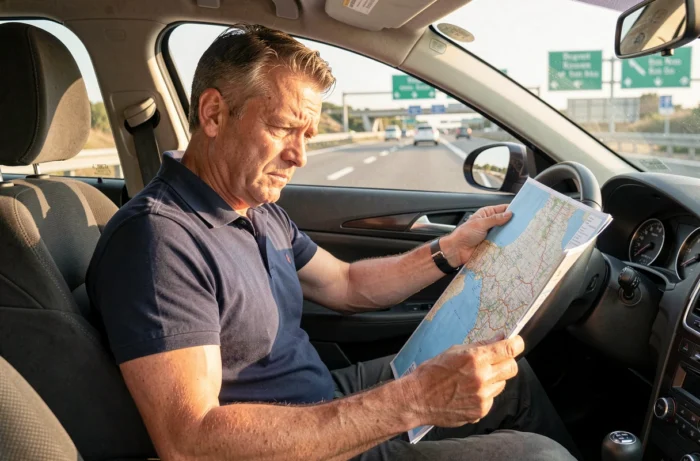
The Spanish motorway network distinguishes two types of expressways by a simple prefix: A for autovía (free) and AP for autopista de peaje (toll). This classification, visible on every sign and every road map, forms the basis for planning a trip without unpleasant surprises when passing through a toll barrier.
Autovía and autopista: two prefixes, two funding logics
Autovías (prefix A) are funded by the state budget or autonomous communities. Their access is free, without barriers or tickets. Toll motorways (prefix AP) operate under private concession: an operator builds or maintains the road, then recoups costs through tolls during the contract period.
The distinction can sometimes be subtle on the ground. The same road can change status along its route. The AP-7, for example, became free on almost the entire Mediterranean axis after several concessions expired, but some local sections remain toll roads.
To easily identify the relevant sections, a map of free and toll motorways in Spain allows for a quick visual overview of the active toll sections and those that have passed under public management.

Expired concessions: which routes have become free since 2018
Since 2018, Spain has seen several major routes transition to free access as concession contracts came to an end. The phenomenon accelerated between 2020 and 2021 and has continued in recent years.
The most significant sections that have become free:
- The AP-4 between Seville and Cadiz, which became free in January 2020, removing a toll on one of the busiest corridors in Andalusia.
- The AP-7 between Tarragona and Alicante, also freed in January 2020, opening the Mediterranean coast without fees for several hundred kilometers.
- The AP-7 between La Jonquera and Tarragona, as well as the AP-2 between Zaragoza and El Vendrell, which became free in September 2021, making entry through the Catalan border much more economical.
- The Alicante ring road on the AP-7, whose definitive liberalization was announced by the Spanish Council of Ministers in December 2025.
With each expiration, the section loses its AP prefix on new maps and takes the A prefix. On the ground, old AP signs sometimes coexist with the new signage, which can cause confusion for a few months.
Toll motorways still in Spain: routes to watch
The paid network is shrinking, but it has not disappeared. Several autopistas remain under active concession, concentrated on specific routes.
The most common tolls encountered by motorists coming from France are found in the Basque Country. The AP-68 between Bilbao and Zaragoza is among the most expensive toll motorways in the country. Its concession ends on November 10, 2026: the sections located in Aragon and La Rioja will then become completely free, while the Basque sections (Álava, Biscay) will remain toll roads, with significantly reduced rates and a free-flow toll system without barriers.
Other paid routes remain around Madrid, Barcelona, and in the northwest of the country. The general trend is towards reducing the concession network, but the timeline depends on each individual contract.
Reading signs before a fork
On the ground, the alert signal is a blue sign mentioning “peaje” or displaying the pictogram of a toll barrier. It systematically appears before the junction, allowing the option to divert to the free alternative (often a parallel autovía or a national road N).
A green sign without a mention of peaje indicates a free access road. This convention is consistent across the entire Spanish network, making it reliable once understood.
Payment methods at Spanish tolls
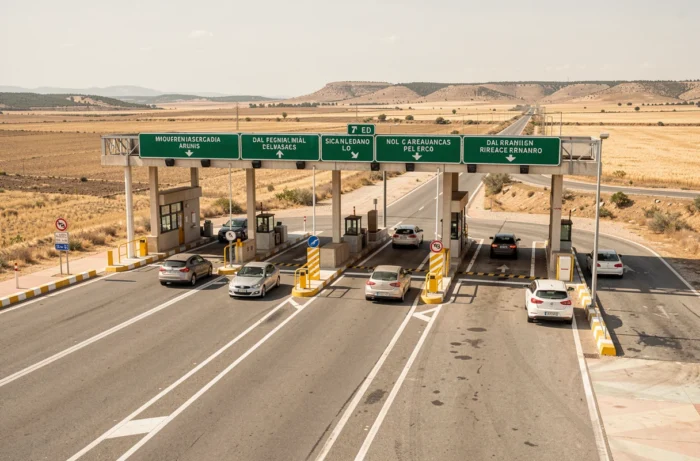
On the still-toll autopistas, three payment methods coexist at traditional barriers:
- Cash payment, accepted in manual lanes (coins and bills).
- Credit card payment, available at automatic kiosks and sometimes at manual lanes.
- The VIA-T toll badge, the Spanish equivalent of the French Liber-t badge, which opens dedicated lanes without stopping. Some European badges are interoperable with the VIA-T system.
On sections transitioning to free flow (like those planned in the Basque Country after November 2026), there are no longer physical barriers. Gantries read the badge or license plate, and billing occurs afterward. Without a registered badge, the vehicle is photographed, and the owner receives a payment notice.
Planning a mixed free and toll trip from France
From the French-Spanish border, two major corridors emerge. From the east (Le Perthus/La Jonquera), the AP-7 is now free up to Alicante, making it the most economical route to the Mediterranean coast.
From the west (Hendaye/Irun), the situation differs. The route to Madrid via Burgos goes through the AP-68 or the autovía A-1. Choosing the A-1 instead of the AP-68 allows avoiding any toll between San Sebastián and Burgos, at the cost of a slightly longer route.
For trips to Seville or Andalusia, the southern axis from Madrid uses free autovías (notably the A-4), making the entire journey toll-free once past the Basque area.
The map of the Spanish network evolves each year with the end of concessions. Checking the status of sections before departure remains the most effective reflex, especially for the AP-68, whose expected change in November 2026 will significantly alter the budget of a north-south trip.