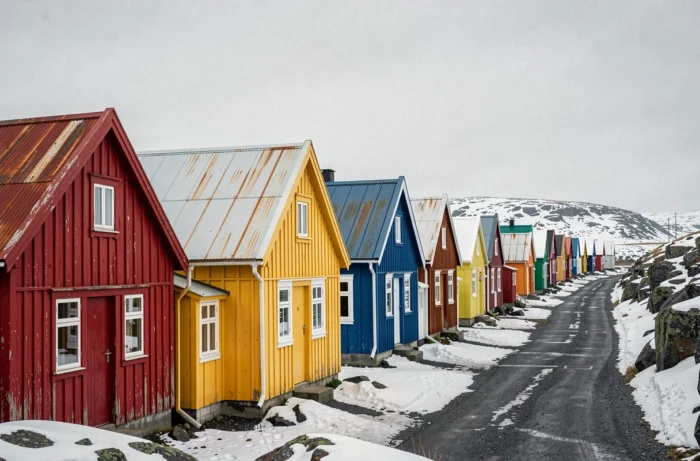
The colorful houses of Greenland are not merely an aesthetic whim. They constituted a functional orientation system, designed for a territory without named streets or building numbers, where visibility drops to just a few meters during the polar night. Understanding why the houses are colorful in Greenland requires going back to the color code imposed by the Danish colonial administration, and then measuring what remains of it today.
Danish Color Code in Greenland: A Functional Mapping, Not Folklore
The color system imported by Danish colonists met a specific need: to identify the function of a building from a distance in degraded visibility conditions. Before the advent of modern signage, the hue of a facade indicated the nature of the service found within.
The correspondences between colors and public functions were more structured than is usually presented in popular articles. We observe a breakdown that covered the main collective services of a Greenlandic locality.
- Yellow houses signaled medical personnel and care centers, allowing for quick identification in case of a health emergency
- Red houses designated administrative buildings, shops, and schools
- Blue houses were associated with fishing activities and warehouses related to the maritime economy
- Green houses corresponded to telecommunication services and the post office
- Black houses identified police stations
This code was not aimed at decoration. It functioned as a system of urban signage before urban planning, in isolated coastal villages where each building had to be recognizable from the sea or from a snow-covered path.
The tradition of painting wood in bright colors also comes from a concrete Scandinavian heritage. The prefabricated houses imported from Denmark and Norway arrived in parts, and the paint served primarily as a protective layer against saline moisture and frost. Falun red, a pigment based on iron oxide used in Scandinavia for centuries, remains one of the most common shades.
To delve deeper into the topic of Inuit dwellings and life in Greenland, the comparison with Iceland offers complementary insights into these Nordic practices.
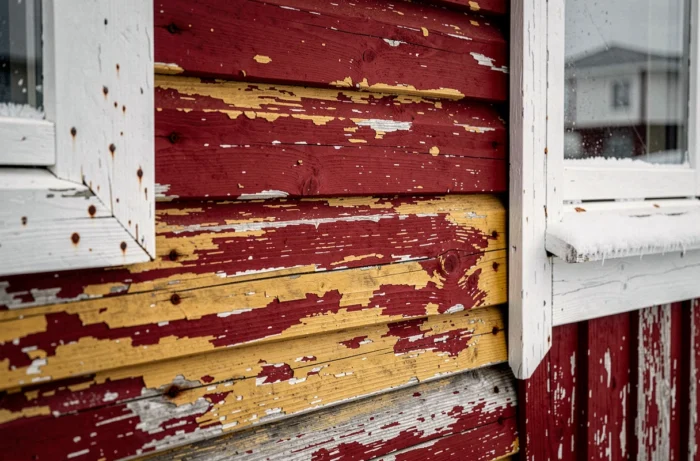
Colorful Houses of Greenland: A Code That No Longer Holds Force
The historical color code is no longer imposed on individuals in most Greenlandic localities. Residents can now paint their houses in the shade of their choice. This freedom changes the reading of the urban landscape.
In cities like Ilulissat or Nuuk, the utilitarian function of colors has given way to an identity function. Greenlanders retain bright hues out of cultural attachment, not regulatory obligation. The original code persists on some public buildings, but it no longer structures the visual organization of residential neighborhoods.
This evolution creates a gap between what travel guides narrate (a codified system still in force) and contemporary reality. A visitor searching for a doctor by spotting a yellow house may end up at a private residence whose owner simply liked that color.
Identity Dimension Against Denmark
The symbolic significance of colorful facades is set within a particular political context. Greenland, an autonomous Danish territory, is gradually asserting its cultural uniqueness. The colorful houses contribute to this assertion. They visually distinguish Greenlandic localities from Danish or Norwegian cities with which they share architectural heritage.
Maintaining bright facades has become an act of cultural appropriation more than a practical reflex. Greenlanders have transformed a code imposed by colonization into their own identity marker.
Wood Construction in Greenland: Technical Constraints and Protective Paint
Almost all Greenlandic houses are built of wood, a material that does not grow locally. Greenland imports its building materials from Scandinavia, which explains the standardization of structures and the architectural kinship with Norway or Denmark.
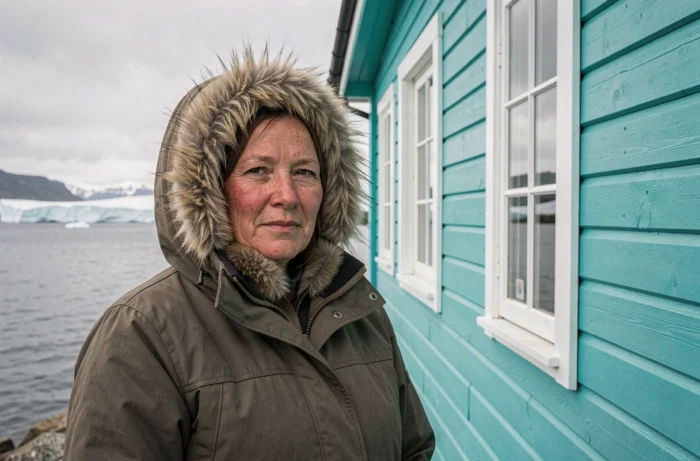
Wood exposed to the Arctic climate faces severe constraints: repeated freezing and thawing, saline humidity, strong winds. Without treatment, a wooden facade deteriorates within a few seasons. The paint primarily serves a protective role before being an aesthetic choice. Iron oxide or copper-based pigments offer superior weather resistance, which explains the historical predominance of reds, greens, and blues.
The choice of bright colors rather than neutral shades is also not trivial from a thermal perspective. Dark pigments absorb more solar radiation, a marginal but real advantage during the short summer sunshine periods. Black houses (reserved for the police in the original code) benefited from this modest thermal gain.
Facade Maintenance in Polar Environments
We observe that the frequency of repainting is significantly higher than in temperate climates. Greenlandic homeowners regularly repaint their facades, which maintains the brightness of the colors and inadvertently sustains the picturesque image of the villages. This maintenance constraint contributes to the constant renewal of the chromatic landscape.
Arctic Tourism and Colorful Houses: Visual Attraction or Living Heritage
Colorful facades have become Greenland’s trademark in tourism promotion. Photographs of Ilulissat, Sisimiut, or Tasiilaq circulate widely, sometimes reducing Greenlandic architecture to a photogenic backdrop.
This tourist instrumentalization raises a concrete question: Does the maintenance of bright colors still respond to local use or to external expectations? In practice, both logics coexist. Greenlanders repaint their houses out of cultural habit and technical necessity. Local authorities encourage the maintenance of colorful aesthetics because it attracts visitors.
The result is a living heritage, neither frozen in an obsolete colonial code nor reduced to a marketing product. The colorful houses of Greenland remain a hybrid object, at the crossroads of Danish heritage, climatic constraints, and a Greenlandic identity claim that the simple aesthetic question cannot summarize.