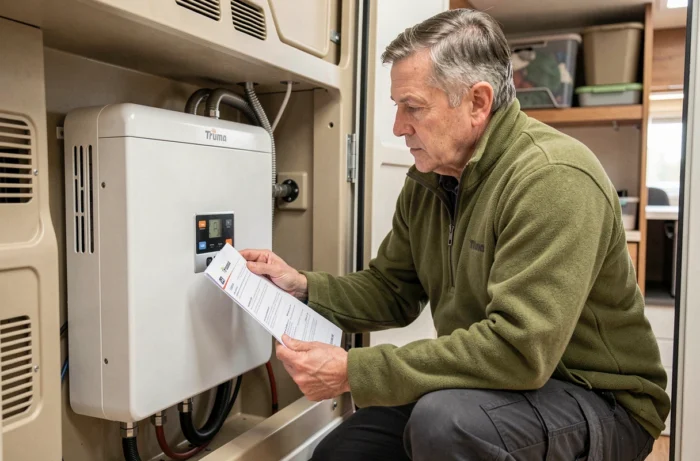
You are in the middle of a bivouac, night is falling, and your Truma heater is displaying an error code on the control panel. Don’t panic. These codes do not always indicate a serious malfunction. They represent a precise diagnosis that the onboard electronics have detected, and most can be resolved without tools or a mechanic.
Truma gas error codes: the temporary lock that no one explains
The most common errors on a Truma heater concern the gas circuit. Empty bottle, supply line primed after a bottle change, regulator frozen in cold weather: the classic causes are known.
What is less known is the behavior of the device after the error. On recent Combi models equipped with a CP Plus panel, certain gas fault codes (notably the E 507, E 516, E 517 family) trigger a temporary lock of about fifteen minutes. During this time, pressing the On button does not restart any ignition sequence.
This silence is not a bug. It is a built-in safety feature that prevents repeated re-ignitions and protects the burner. If you check the list of Truma error codes with their troubleshooting tables, you will find that these codes are systematically associated with a blocking delay. There is no need to attempt a reset during this time: you simply have to wait for the lock to expire, then restart the device.
- E 507: flame detection failure after three successive ignition attempts, spaced about thirty seconds apart.
- E 516 / E 517: anomalies in the gas circuit or supply line, often related to incomplete purging after a bottle change.
- After the locking delay, a simple restart is sufficient in most cases if the initial cause (empty bottle, closed valve) has been corrected.
Battery voltage errors: those phantom failures that appear at night
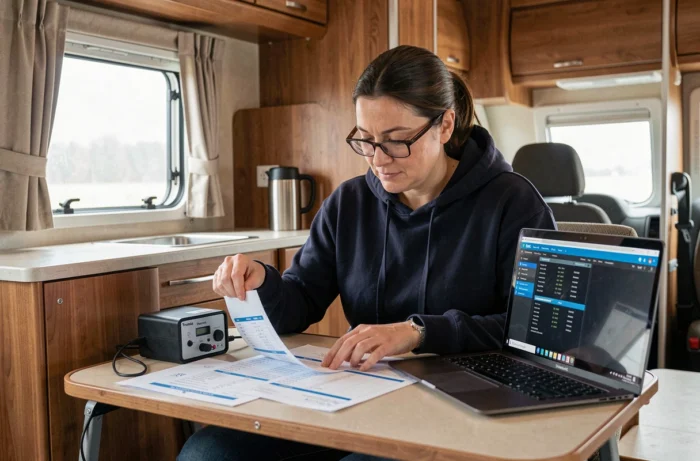
Have you ever noticed that an error code appears in the middle of the night, while everything was working perfectly in the evening? The Truma heater constantly monitors the voltage of the service battery. When it drops below a certain threshold, the electronics shut off the heating and display a low voltage code.
The trap is that this voltage drop is often temporary. It occurs when the battery is being used by other consumers (refrigerator, lighting, water pump). The error code disappears as soon as the voltage rises, for example, when the engine starts or when plugged into mains power.
Conversely, an excess voltage can also cause errors. A poorly calibrated charger or a faulty coupler sends too high a voltage, and the control panel indicates an anomaly. These so-called “phantom” errors do not indicate a heating problem, but an issue with the electrical circuit of the vehicle.
Checks to make before calling a technician
Measure the voltage at the terminals of the service battery with a simple multimeter. If it is below the normal operating threshold, recharge before restarting the heater. If the voltage is correct and the code persists, the problem is likely with the connection between the battery and the device (oxidized terminals, worn fuse, undersized cable).
Truma CP Plus panel: reading and interpreting the display of codes
The CP Plus control panel displays errors in the form of alphanumeric codes (letter E followed by numbers). Other Truma devices, such as the AquaGo water heater, use a different system: short and long flashing sequences on an LED.
For the AquaGo, the principle is simple. Each code corresponds to a combination of flashes that repeats every three seconds. A short flash counts as 0, a long flash counts as 1. For example, seven short flashes followed by one long correspond to code 1, which indicates a flame not detected after gas distribution and ignition.
The common reset procedure for most devices
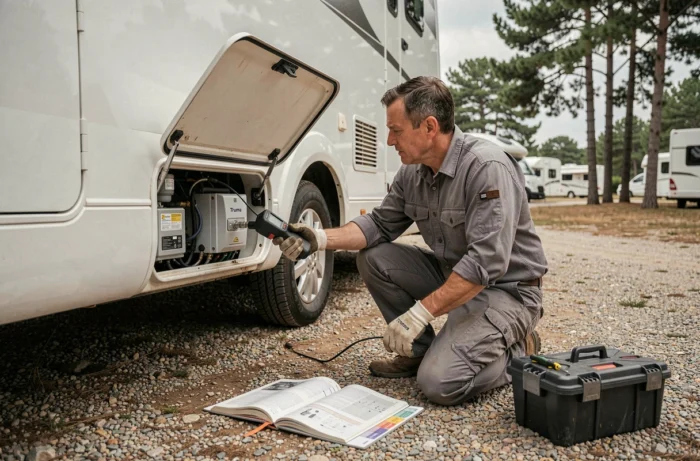
Regardless of the model, the first action in response to an error code remains the same:
- Completely turn off the device via the control panel or the main switch.
- Wait at least five seconds (and up to fifteen minutes if a temporary lock is active).
- Turn the device back on and observe if the code reappears.
- If the code persists after two or three attempts, note the displayed code precisely and contact an authorized Truma service center.
Attempting to force a restart in a loop does not resolve anything and can, in some cases, worsen a mechanical problem with the burner or ventilation.
Truma heating in mixed gas and electric mode: specific errors
The Combi units operating in mixed mode (gas + electric resistance) add a layer of complexity. An error code can pertain to the gas circuit, the electric circuit, or both simultaneously.
When mixed mode is active and the 230 V power supply is cut off (disconnection of the mains cable, circuit breaker tripping), the device normally switches to gas only. If the switch fails, an error code appears, often related to a flame detection failure, as the system attempts a gas ignition under unsuitable conditions.
User feedback from converted vans indicates that this type of error occurs more frequently after prolonged operation in mixed mode, followed by a sudden power cut. The solution is to properly turn off the device, wait for the safety delay, then restart by manually selecting the gas-only mode before reactivating mixed mode.
Keeping a summary table of codes in the vehicle, within reach, remains the most useful reflex. A quickly identified code avoids unnecessary manipulations and helps distinguish what can be resolved independently from what requires a visit to an authorized workshop.