
White vinegar is a diluted acetic acid, typically concentrated between 8 and 14% depending on household packaging. When applied to limestone, it dissolves it through a chemical reaction. When applied to the internal components of a spa, such as seals, pumps, and heaters, it can cause damage that is often only detected after several weeks of use.
The challenge lies in this duality: white vinegar works against mineral deposits, but its acidity also attacks materials that were not designed to withstand it. Understanding where the risk begins allows for its use without compromising the longevity of the equipment.
Acetic acid and spa materials: what acidity actually attacks
A rigid or inflatable spa combines several materials with very different chemical tolerances. The acrylic shell can withstand brief contact with a weak acidic solution. However, the silicone seals and mechanical fittings of the pump degrade with repeated contact with acetic acid.
Recent recommendations on the maintenance of sanitary equipment confirm that pure vinegar progressively alters silicone: it softens the surface, promotes micro-cracks, and ultimately compromises the seal. This phenomenon accelerates in warm environments, precisely the conditions of a functioning spa.
The vinyl of inflatable spas presents a comparable vulnerability. Prolonged contact with an overly concentrated solution discolors the surface and weakens the weld of heat-sealed seams. On metal jets and nozzles, acetic acid can also tarnish chrome finishes if the contact time exceeds a few minutes.
Some manufacturers explicitly prohibit vinegar or any acidic cleaner in their user manuals, particularly for the hydraulic circuit and the heater. Before any use, checking the manual for the specific model remains the most reliable precaution, as emphasized by the dkomdecofr guide for your spa, which details warnings by type of equipment.
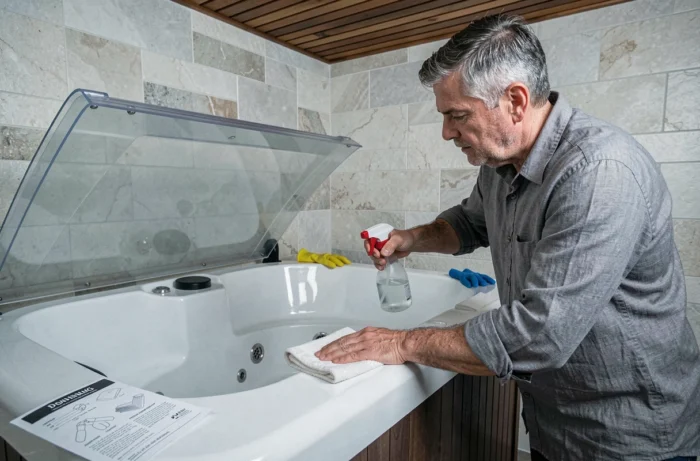
Dilution and contact time: the two variables that determine risk
White vinegar only becomes problematic when its concentration or application duration exceeds a threshold. These two parameters are linked: a very diluted solution tolerates longer contact, while pure application requires almost immediate rinsing.
Appropriate dilution for surface cleaning
For the waterline, thermal cover, or the exterior of the shell, a dilution of one part vinegar to one part water reduces aggressiveness while maintaining anti-limescale effectiveness. This ratio regularly appears in recent sanitary maintenance guides as a safety threshold for silicones and glass surfaces.
Rinsing with clear water after each application is mandatory, even on a surface that seems less sensitive. Residues of acetic acid continue to act as long as they are not removed.
Soaking filters: a regulated exception
Soaking a filter cartridge in a vinegar solution is part of common practices. The cartridge, usually made of pleated polyester, withstands moderate acidity well. The risk does not lie with the filter itself but with what happens afterward: if the poorly rinsed cartridge is reinserted into the circuit, traces of acetic acid enter the plumbing and the pump.
- Soak the cartridge in a separate bucket, never in the spa tub filled with treated water.
- Rinse the cartridge thoroughly under running water before reinstalling it, paying special attention to the folds of the filter media.
- Do not reuse the soaking solution to clean other spa components: it contains organic residues trapped by the filter.
White vinegar in the spa’s hydraulic circuit: why to avoid it
Circulating diluted white vinegar in the internal circuit of a spa (by pouring it directly into the water and then activating the pumps) is the riskiest practice. Acetic acid then comes into contact with the pipes, the mechanical fittings of the pump, and the heat exchanger of the heater.
Acetic acid can damage internal plumbing and pump seals in less than one season of regular use. The problem is cumulative: each passage degrades the internal surfaces a little more, without visible signs from the outside. When a leak appears or the pump loses pressure, replacing the component is the only solution.
Vinegar also disrupts the TAC (total alkalinity) of the water permanently. TAC measures the water’s ability to resist pH fluctuations. A TAC that is too low makes pH unstable, which necessitates frequent chemical corrections and exposes the shell to corrosive conditions.
For cleaning pipes, specific purge products exist. Formulated to dissolve the biofilm (the bacterial film that lines the inside of pipes) without attacking seals or pumps, they fulfill the function that vinegar cannot perform without collateral damage.
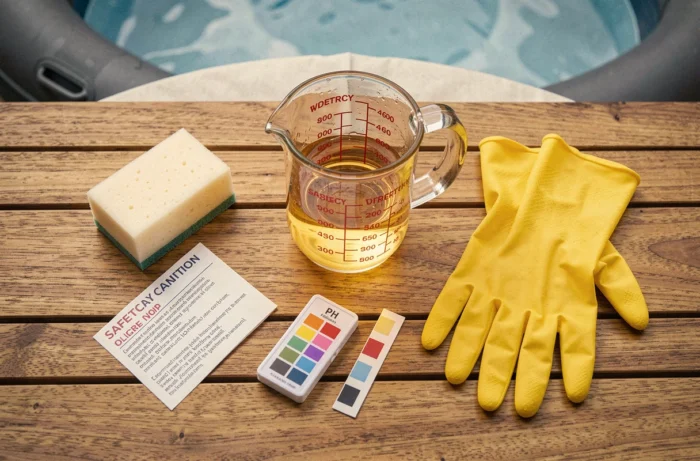
Compatible surfaces and risk-free method for white vinegar
White vinegar remains relevant for certain specific tasks, provided it is limited to external surfaces and a strict protocol is followed.
- Waterline and acrylic shell edges: apply the diluted solution with a soft microfiber cloth (never an abrasive sponge), let it sit for one to two minutes, then rinse. The microfiber cloth prevents scratches on the acrylic, which mark irreversibly.
- Thermal cover and exterior face of the spa: the diluted solution removes limescale stains and superficial mold deposits. Rinse with low-pressure water.
- Headrests and removable cushions: check beforehand that the material is not a UV-treated vinyl, as some surface treatments react to acid. In case of doubt, a neutral detergent is preferable.
- Faucets and jets: a quick wipe with a damp cloth is sufficient for visible limescale. Never soak chrome parts in a vinegar solution.
The spa has enough external areas where white vinegar can fulfill its role without risk that there is no need to introduce it into the internal circuit. The chemical maintenance of the water and plumbing relies on products formulated for this use, with controlled pH and agents compatible with permanently contacting materials.
One last often-overlooked point: after any cleaning operation with vinegar, testing the pH and TAC of the water before restarting filtration allows for the detection of any potential acid contamination of the basin. If the TAC has dropped, a correction with sodium bicarbonate brings alkalinity back into the stability range before the imbalance produces its effects.