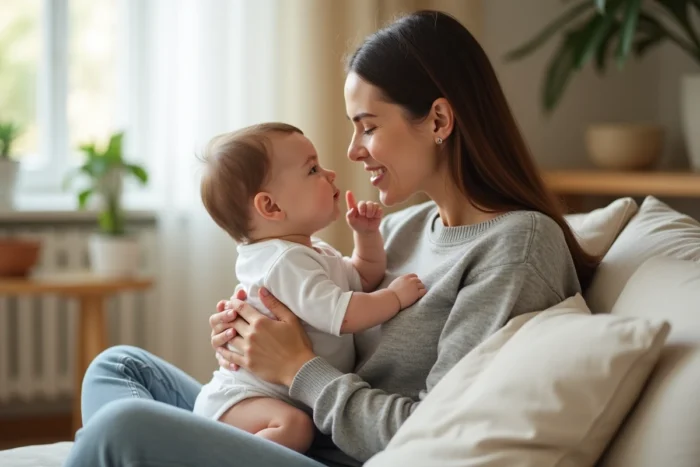
During breastfeeding or a simple cuddle, the baby raises their hand and places their fingers on their mother’s cheek, nose, or mouth. This gesture, which most parents find endearing without much thought, actually mobilizes sensory and relational skills that the infant develops well before birth.
Facial Touch in the Fetus: A Reflex Already Programmed In Utero
It is often thought that the baby discovers the maternal face at birth. Research tells a different story. Studies conducted at the universities of Durham and Lancaster show that, towards the end of pregnancy, the fetus opens its mouth before its hand reaches the chin area, indicating that it anticipates contact with its own face rather than reacting reflexively.
Researcher Nadja Reissland interprets these movements as a brain preparation for three functions: social interaction, self-soothing, and feeding. When we understand why babies touch their mother’s face, we realize that this postnatal gesture extends a pattern already established in the womb.
It is therefore no coincidence that, from the very first hours of life, the newborn spontaneously brings their hand to the face of the person holding them. The nerve circuit already exists; it simply seeks a new target.
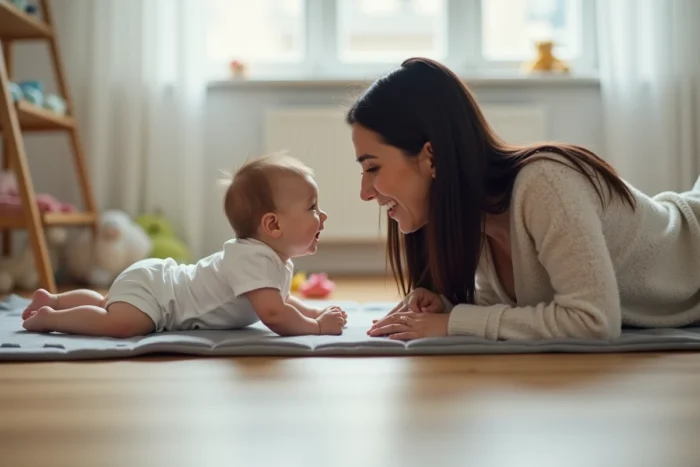
Facial Sensory Exploration: What the Baby’s Hand is Really Seeking
An infant does not see very well. During the first weeks, their vision remains blurry beyond a few dozen centimeters. Touch compensates for this limitation by providing information that the eyes cannot yet capture.
Mapping the Contours of the Maternal Face
The nose, lips, and eyebrows have different textures and temperatures. By running their fingers over these areas, the baby constructs a tactile map of the face that complements the blurry visual image they perceive. This dual sensory input (sight and touch combined) helps their brain recognize their mother among other adults.
It is often observed that the baby focuses on the mouth. The reason is straightforward: it is the area that moves the most when the parent speaks or smiles. The movement attracts the hand, and the contact reinforces the infant’s attention on this source of communication.
Temperature and Texture as Safety Cues
The skin of the face is warmer and smoother than that of the arm or hand. For an infant, the warmth of the maternal face signals closeness and availability. Responses vary on this point among children, but many babies who touch their mother’s face calm down faster than when they grasp a piece of clothing or an object.
Non-Verbal Communication of the Infant: Touch Before Words
Before they can babble, the baby has a limited but effective gestural vocabulary. Facial touch is part of this, alongside sustained eye contact or arm movements.
- Placing a hand on the cheek during breastfeeding may indicate a need to slow down the flow or simply a moment of shared comfort.
- Tapping the chin or nose is often associated with a request for attention: the baby is trying to catch the parent’s gaze.
- Grabbing the ear or hair is more about motor exploration, with the infant testing their grasping ability on various shapes.
What distinguishes these gestures from random movements is their repetitive and directed nature. A baby who touches an object often lets it go quickly. A baby who touches their mother’s face returns to it again and again because the face responds: an expression changes, a voice modulates, a smile appears.
Parent-Baby Attachment and Parent Response to Touch
The baby’s gesture does not operate in a closed circuit. Its significance largely depends on how the parent responds.
When an infant places their hand on their mother’s face and she smiles, kisses their palm, or changes the tone of her voice, she sends a signal of reciprocity. This positive feedback strengthens the attachment bond by creating an interaction loop. The baby learns that their gesture produces an effect, which encourages them to communicate more.
Recommendations around “connection moments” between parent and baby emphasize the quality of presence over the quantity of stimulation. Observing the baby’s gesture without redirecting it, allowing the hand to explore without pushing it away: this silent availability is as important as structured play.
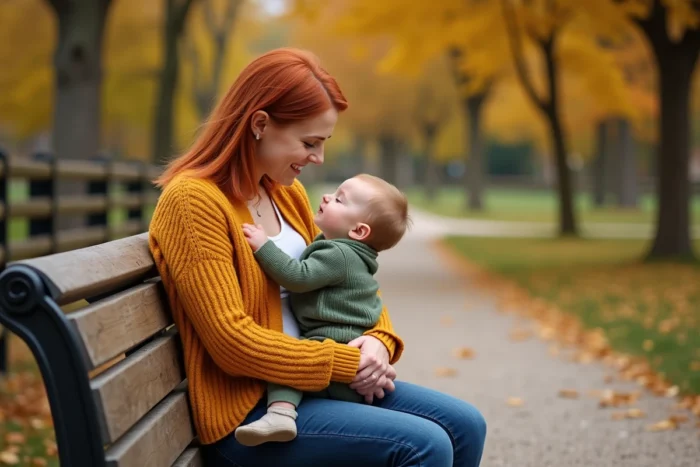
When Facial Touch Becomes Intense or Insistent
Some babies do not just place their hand. They scratch, pull, or press hard. This behavior can be puzzling, but it does not indicate aggression. The infant has not yet mastered the pressure of their fingers or the fine coordination of their hand.
- A tired or overstimulated baby may intensify physical contact to seek quick soothing.
- A hungry baby may touch their mother’s mouth by association with feeding, the pattern being linked to what they practiced in utero on their own face.
- A baby in a phase of motor awakening (around four to six months) is simply testing the strength of their grasp on everything within reach, including faces.
Rather than pushing the hand away, one can gently guide the baby’s fingers to a less sensitive area (the cheek rather than the eye) while maintaining contact. Redirecting without breaking the connection preserves the infant’s trust in tactile exchange.
Facial Touch and Baby’s Brain Development
Each contact between the baby’s hand and the skin of the maternal face simultaneously activates the tactile, visual, and emotional areas of their brain. This multiple activation is precisely what makes this gesture so formative compared to other sensory explorations.
The human face concentrates dense information: emotions that change in real-time, fine muscle movements, sounds associated with mouth movements. For the infant’s brain, the maternal face is the richest and most responsive stimulus in their environment. No toy, no matter how well designed, replicates this complexity.
This observation does not mean that contact should be forced or that one should worry if a baby touches their parents’ faces little. Temperaments vary, and some infants prioritize gaze or voice as their main communication channel. Facial touch remains one indicator among others of sensory and relational development that follows its own pace.