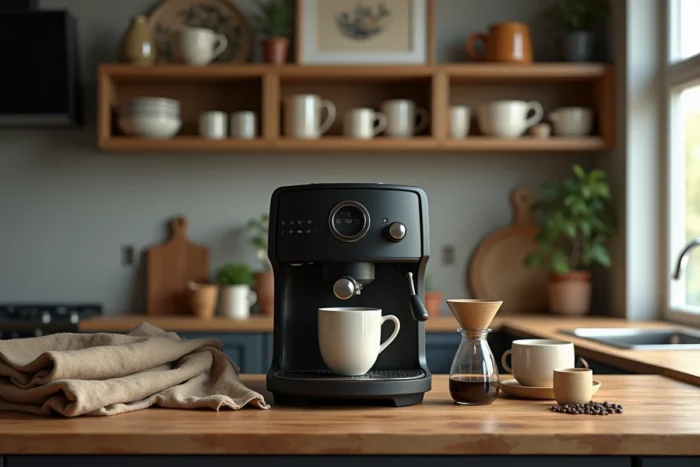
Creating a coffee space at home is not just about placing a machine on a countertop. Between choosing the furniture, the quality of the water, the ergonomics of storage, and the traceability of the coffee itself, the factors that separate a functional corner from a true daily ritual are more technical than aesthetic. What criteria truly weigh in the success of such an arrangement?
Water Quality and Extraction: The Invisible Factor of the Home Coffee Corner
Articles about home coffee corners almost all focus on the machine, the decor, or the choice of cups. None of the competitors analyzed address the parameter that most influences the taste in the cup: water makes up more than 90% of the volume of an espresso.
Water that is too hard clogs the machine and produces flat coffee. Conversely, water that is too soft accentuates acidity and makes extraction aggressive. For a home coffee space that lives up to its promises, the first useful expense is not a high-end grinder, but a suitable water filter jug or a compact softener installed upstream of the machine.
Before investing in expensive equipment, test the hardness of your water with a strip (available at pet stores or online for a few euros). The result guides everything else: type of machine, frequency of descaling, choice of filter. A technical detail that many enthusiasts discover after months of disappointing coffee, and which deserves to be addressed right from the design of your coffee corner in the kitchen or living room.
On Espress Home, product sheets detail the technical characteristics of the machines, allowing you to cross-reference this data with the quality of your local water.
Coffee Machine, Furniture, and Accessories: Where to Place Your Budget
The classic temptation is to concentrate the budget on the coffee machine and neglect everything else. However, feedback shows that the ergonomics of the furniture and storage are just as important as the machine in daily satisfaction.

Here is a comparison of expenditure items according to two layout approaches:
| Item | “All on the Machine” Approach | Balanced Approach |
|---|---|---|
| Coffee Machine (espresso, filter) | Majority of the budget | Moderate share, mid-range |
| Dedicated Coffee Grinder | Often absent | Present (improves freshness) |
| Dedicated Furniture or Shelf | Existing countertop | Appropriate furniture with integrated storage |
| Water Filtration | Neglected | Filter jug or inline filter |
| Accessories (cups, scale, tamper) | Purchase scattered over time | Coherent kit from the start |
| Satisfaction at 6 months | Often mixed | Significantly higher |
The balanced approach does not necessarily cost more. It reallocates priorities differently. Dedicated furniture with a shelf or niche allows you to group the machine, grinder, cups, and coffee in one place, eliminating trips to the kitchen and transforming preparation into a fluid gesture.
Micro-Technical Layout for Small Spaces
Setting up a coffee corner in a studio or narrow kitchen involves micro-layout. The constraint is not the available surface area, but the proximity between an electrical outlet, a water point, and vertical storage.
Three technical principles to respect:
- The machine must be located within one meter of an outlet. Extension cords in a damp area pose a safety issue, and visible cables disrupt the ambiance of the coffee corner.
- An accessible water point (kitchen sink, filtered fountain) avoids crossing the room with a full reservoir. In a living room, a small filling pitcher placed on the furniture is sufficient.
- Vertical storage (wall shelf, built-in niche) frees up the countertop. A cluttered coffee space discourages daily use within weeks.
In small spaces, an unused wall corner between the kitchen and dining room often constitutes the best location. This nook, too narrow for a traditional piece of furniture, perfectly accommodates a 40 cm deep shelf with a shelf above.
Coffee Traceability and the European Anti-Deforestation Regulation
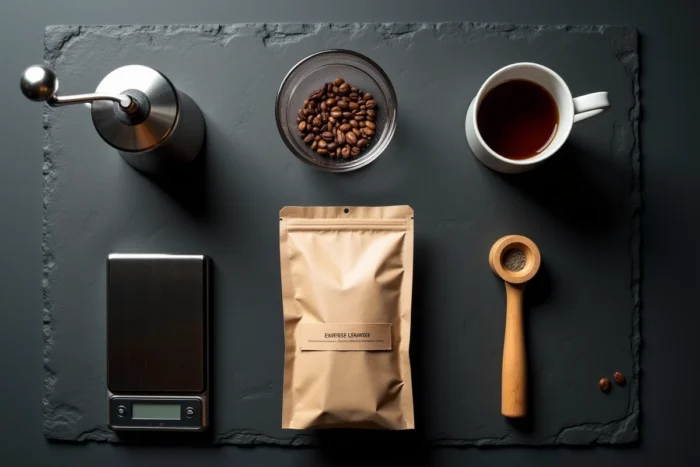
Since June 30, 2025, the European Anti-Deforestation Regulation (EUDR) requires any operator placing coffee on the EU market to prove, through a due diligence declaration in the TRACES system, that the coffee is not linked to deforestation. Traceability goes back to the origin plots, with a “zero deforestation” certificate since December 31, 2020.
For an individual setting up their coffee space, this changes the game regarding the choice of beans. Artisan roasters who document the origin of their batches already meet these requirements. On the other hand, bulk coffees sold without origin indication become harder to trace.
Choosing a roaster that displays the origin plot ensures both regulatory compliance and superior taste quality. Specialty coffee, by definition traceable, naturally fits into this logic.
Decor and Ambiance of the Coffee Corner: What Professional Trends Teach
Professional coffee shops work on three axes that home layouts often neglect: a limited color palette, noise management, and greening.
- A palette of two or three shades (light wood, white, a touch of green or terracotta) visually unifies the coffee corner and distinguishes it from the rest of the kitchen or living room.
- The noise of the machine (integrated grinder, pump) can be managed by placing an anti-vibration mat under the device, especially in a relaxation space or an open dining room.
- A small plant (pothos, ivy) placed on the shelf softens the overall look and recalls the atmosphere of specialty cafes, without requiring complex maintenance.
These choices are not merely decorative whims. They contribute to creating a complete sensory ritual, from the preparation gesture to tasting in a carefully chosen cup.
The real secret to a successful coffee space lies less in the amount invested than in the coherence between water, machine, storage, and beans. Addressing water quality before choosing the machine remains the least applied yet most decisive advice.