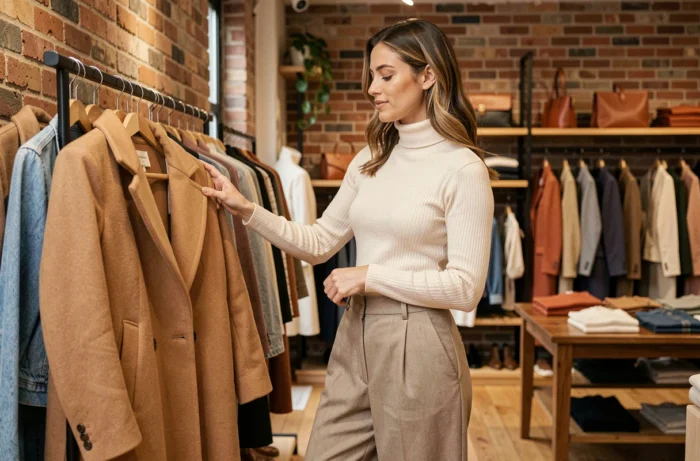
Each new season brings its share of pieces, colors, and materials highlighted by fashion shows and brands. Adopting the fashion trends of this season is not just about accumulating purchases: the choice is based on measurable criteria such as the versatility of a piece, its regulatory durability, and its ability to integrate into an existing wardrobe.
European Regulation and Fashion Trends: What Changes for Consumers
Two European texts are concretely changing the way brands present their collections this season. Their direct impact on product sheets and labels deserves to be assessed before any purchase.
Since July 19, 2026, the ESPR regulation (Ecodesign for Sustainable Products Regulation, EU 2024/1781) prohibits large companies from destroying unsold new clothing and shoes in the European Union, except for safety reasons. This obligation pushes brands to increase clearance sales, outlet channels, and second-hand programs.
As of September 27, 2026, the directive (EU) 2024/825, known as Empowering Consumers for the Green Transition, will make vague environmental claims on product sheets illegal. Terms like “eco-friendly,” “green,” or “environmentally friendly” will disappear unless the brand provides verifiable proof. In practice, the labels of trendy pieces must now display factual data: composition, lifespan, reparability.
| Regulation | Effective Date | Impact on Fashion Trends |
|---|---|---|
| ESPR (EU 2024/1781) | July 19, 2026 | No more destroyed unsold items: increased sales, outlets, second-hand |
| Directive (EU) 2024/825 | September 27, 2026 | End of vague greenwashing: mandatory factual labels |
These two texts change the game for those wishing to adopt a seasonal trend. A “trendy and eco-responsible” piece displayed without concrete proof will soon be in violation. Cross-referencing the information published on Mademoiselle C’s fashion blog with labeling data allows filtering genuine commitments from mere marketing arguments.

Autumn-Winter Trend Colors: Identifying Those That Last Beyond a Season
The autumn-winter 2026-2027 fashion shows highlight several palettes. Not all have the same longevity potential in a wardrobe.
Bordeaux returns as the key color of the fall 2026. Its recurrence over several consecutive seasons makes it a low-risk choice: a bordeaux blazer or knit can be reused year after year without looking dated.
Chocolate, ecru, and khaki tones establish themselves as alternative neutrals to black and gray. Their appeal lies in their mutual compatibility: these three shades combine effortlessly, reducing the number of pieces needed to create varied looks.
In contrast, butter yellow, which is very present on the spring-summer 2026 runways, poses a seasonal transition problem. Wearing this shade in autumn requires more thoughtful combinations (layering with heavier materials, dark accessories). The piece risks remaining unused for several months.
- Bordeaux and chocolate offer the best trend/longevity ratio: wearable over several seasons without renewal
- Ecru and khaki function as neutral bases, compatible with most seasonal prints
- Strongly marked colors (butter yellow, bright green) remain occasional choices: it’s better to integrate them via an accessory rather than a key piece
Key Pieces of the Season: Jacket, Jeans, and Dress from a Cost per Use Perspective
Rather than listing trends, an analytical approach involves evaluating each piece based on its expected frequency of use. Cost per wear remains the best indicator for deciding between two seasonal purchases.
Structured Blazer and Colorful Short Jacket
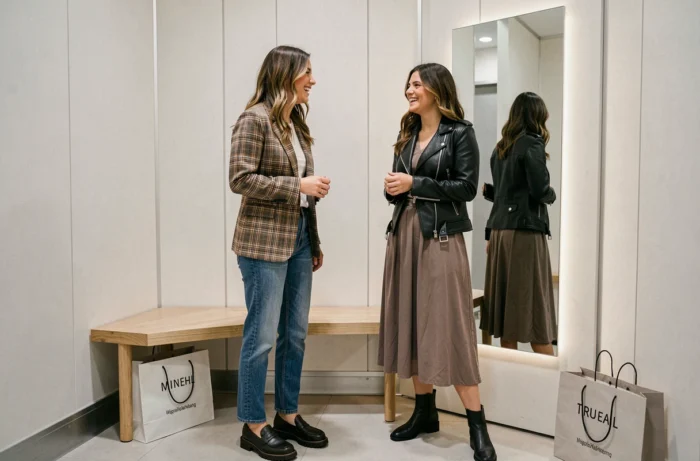
The blazer has returned every season for several years. Its versatility (office, evening, weekend) makes it a piece with a very low cost per wear. The colorful short jacket, a trend for spring-summer 2026, offers a more limited range. Its use is confined to casual outfits and mild mid-seasons.
At equivalent prices, the blazer generates more possible combinations. The colorful short jacket works better as a complement than as a main piece.
Straight Jeans, Barrel Jeans, and Fluid Pants
The barrel jeans (loose fit, tapered at the ankle) assert themselves as the silhouette of the season. Its compatibility with both sneakers and heeled ankle boots gives it a wide range of use. Straight jeans remain a basic, but their more classic silhouette makes them less distinctive this season.
Fluid pants represent the most versatile alternative for professional or dressed contexts. In lightweight material, they transition from spring to autumn with a simple change of upper layer.
Midi Dress and Oversized Sweater
The midi dress worn with high boots creates a complete autumn look in a single piece. The oversized sweater, a confirmed trend for spring-summer 2026, can be worn over a dress or pants and adds a layering dimension without additional purchase.
Materials and Labeling: Reading a Fashion Product Sheet in 2026
The new European regulation changes what a product sheet must contain. To adopt the trends of this season in an informed manner, three elements deserve systematic verification.
- Exact Composition: a “wool sweater” that contains less than half wool in its composition will not last several seasons. Check the actual percentage of the main fiber
- Sustainability Mentions: with the directive (EU) 2024/825, any environmental claim must be backed by proof. The absence of visible proof on the product sheet is a warning signal
- Reparability and Maintenance: some brands are beginning to indicate a reparability index or detailed maintenance instructions, a sign of a product designed to last
These criteria do not replace the love at first sight, but they allow you to distinguish a trendy disposable piece from a clothing investment. A garment that meets these three points retains its usability value long after the season ends.
The autumn-winter 2026 fashion trends are now viewed through a dual filter: the aesthetics of the runways and the constraints of European regulations. Bordeaux, the structured blazer, and barrel jeans combine seasonal attractiveness with reuse potential. Before purchasing the trendy piece of the moment, a look at the label and product sheet provides information that the visual alone does not offer.