
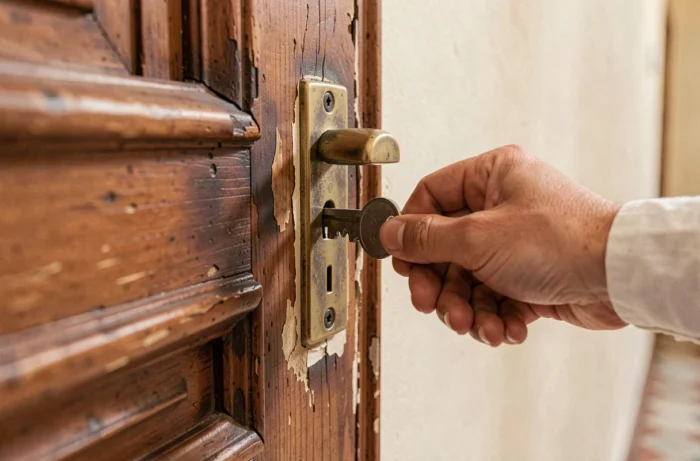
A south-facing front door in the middle of summer, a key that refuses to turn at 6 PM when the sun has been beating down all day: we all know this situation. The problem doesn’t always come from the lock itself. Heat alters the dimensions of the frame, the door leaf, and the metal parts, and it’s often this shift of a few tenths of a millimeter that blocks everything.
Thermal expansion of the frame: the real cause of a lock blocked by heat
When we talk about a lock being stuck in summer, the reflex is to suspect the cylinder. In most cases, the internal mechanism works properly. The blockage comes from the door frame or the door leaf that expands due to the heat, misaligning the bolt with the strike plate.
The test is simple: open the door and try to turn the key in the empty space. If the key turns normally with the door open, the problem is with the door-frame alignment, not the cylinder. This is a diagnosis that anyone can make in thirty seconds before making a decision.
PVC and solid wood doors are the most sensitive. PVC deforms under prolonged sun exposure, while wood swells with heat and residual humidity. Aluminum or steel doors move less, but their seals and fittings can also play a role in friction.
Finding a solution for a stuck lock starts with this diagnostic step, before touching the mechanism or forcing anything.
Concrete actions to unlock a lock without damaging it
When you’re in front of your door with a key that won’t turn, the temptation to force it is strong. You push, pull, shake the key. Each of these actions can bend a pin, break the key in the cylinder, or damage the strike plate. Here’s what works in practice.
Relieve pressure on the bolt
The first thing to do is to push or pull the door leaf towards the frame while turning the key. Maintain a constant lateral pressure with your shoulder or free hand to compensate for the misalignment caused by the expansion. In many cases, this is enough.
If the door is swollen to the point that this maneuver doesn’t work, you can try to slightly lift the door leaf by holding it by the handle. On older doors with worn hinges, the door leaf often sags by a few millimeters in summer, which worsens the misalignment.
Properly lubricate the cylinder
When the blockage persists, we move on to lubrication. But not with just anything. A greasy lubricant (classic WD-40, cooking oil) attracts dust and sticks the pins in the medium term. What we want:
- Dry graphite powder lubricant: blow a small amount into the keyhole, then insert and remove the key several times to distribute the product on the pins
- Dry spray lubricant based on PTFE (Teflon): same use, suitable if you don’t have graphite on hand
- Pencil lead as a backup: rub the key with the lead to deposit graphite on the notches, then insert it into the cylinder
Feedback varies on the effectiveness of pencil lead depending on the type of cylinder, but in an emergency situation, it’s a gesture that carries no risk.
Preventive adjustments before the hot season
Waiting to be locked out in the middle of a heatwave is not the best strategy. A few adjustments in spring can prevent most summer blockages.
Adjusting the strike plate is the most effective action. On an adjustable strike plate (common on newer doors), loosen the fixing screws, reposition the plate a few millimeters to allow play for the bolt, then tighten. On a fixed strike plate, a slight filing of the opening may suffice.
Check the hinges as well. Loose hinge screws cause the door leaf to sag, which the heat exacerbates. A simple tightening with a Phillips screwdriver fixes the problem.
- Clean the cylinder once a year with a dry lubricant to prevent residue buildup
- Check the condition of the door seals, which can swell and create additional resistance
- On wooden doors, apply a stain or varnish to the edges to limit moisture absorption and deformation
Home insurance and locks blocked by heat: what is covered
We are often asked: does home insurance cover locksmith fees when the lock jams due to heat? The answer is almost always no.
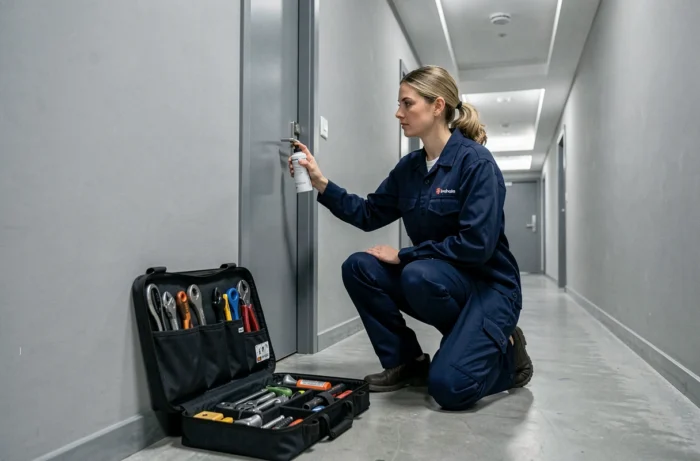
Home insurance contracts cover locksmith fees in case of burglary, theft, a slammed door, or lost keys. A lock blocked by thermal expansion does not fall into any of these categories. Some contracts offer an “emergency locksmith assistance” option, but it is usually capped and subject to conditions.
Before calling an emergency locksmith (and paying the associated rate), it is therefore in your best interest to test the actions described above. If the blockage persists and you need to call a professional, ask for a quote before any door opening, and check online reviews to avoid scams that multiply during heatwaves.
When the cylinder is truly the issue
If the key is stiff whether the door is open or closed, the problem is internal to the mechanism. The pins may be stuck, a spring may be broken, or the cylinder may be worn to the point that the heat finishes blocking it.
In this case, replacing the cylinder is often more cost-effective than repairing it. A cylinder of decent quality (EN 1303 standard, resistance to pulling) can be installed in a few minutes with a simple screwdriver. Remove the fixing screw on the edge of the door, push out the old cylinder, and insert the new one.
The key point to watch: the length of the cylinder must exactly match the thickness of the door. A cylinder that is too long and protrudes from the outside poses a security risk, as it can be grabbed and pulled out.
Repairing a lock blocked by heat generally requires neither special tools nor locksmith skills. The open-door diagnostic step remains the gesture that saves the most time and avoids unnecessary interventions.