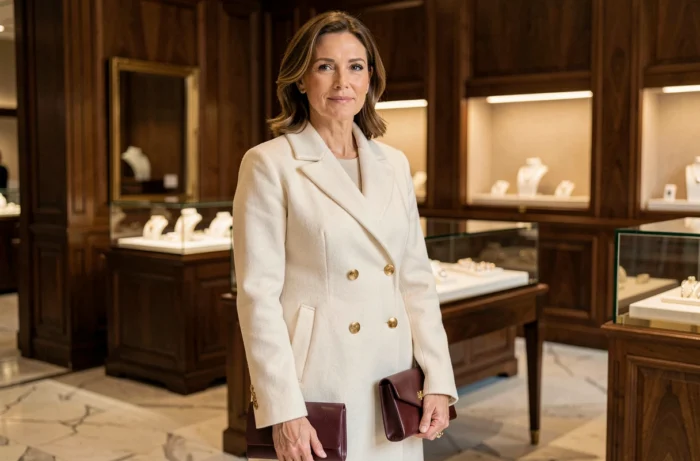
When a Parisian jewelry house presents a collection where titanium replaces white gold on certain statement pieces, it becomes clear that 2024 is not just about a simple change of palette. The luxury market is undergoing a transformation that affects both fashion and the art of living, with a clear shift in demand towards experiences rather than physical products.
According to the Bain & Company study with Altagamma, the global market for personal luxury goods is expected to decline by about 2% in 2024, around 363 to 364 billion euros. The overall luxury market remains stable at nearly 1.48 trillion euros, driven by hospitality, dining, and wellness.
Decline of personal luxury goods and shift towards experiential
Between 2022 and 2024, approximately 50 million consumers have left the category of personal luxury goods. This is not a marginal erosion but a significant movement.
Specifically, buyers who used to spend on bags or watches are redirecting their budgets towards high-end travel, wellness retreats, and exceptional dining. Demand is shifting towards experiences with high emotional value rather than physical objects.
For French houses, this shift alters the growth equation. Brands that invest in the experiential dimension of their boutiques, whether in Paris or in Asian capitals, attract a clientele that product catalogs alone can no longer retain. The news and analyses shared on mondeduluxe.fr illustrate this tension between product heritage and the service-oriented shift.
Fashion and couture in France: what the market contraction changes
The reflex might be to think that French couture houses are experiencing this decline in the same way as the rest of the sector. Returns on this point vary. Some Parisian brands are showing solid results thanks to strategies of scarcity and controlled distribution.
Luxury no longer buys status but quality and experiences. This is evident in the choices of collections: fewer pieces produced, traceable materials, limited drops that create real urgency rather than just marketing.
Scarcity and authenticity as growth levers
Brands that are performing well in 2024 share a common point: they reduce their exposure to volumes to enhance the perception of scarcity. In practice, this translates to capsule collections distributed in a few selected boutiques, often in Paris or flagship stores in Asia.
The Chinese market illustrates this shift. The young Chinese clientele is gradually moving away from ostentatious logos in favor of discreet, well-tailored pieces, where value lies in craftsmanship rather than brand visibility. High-end cosmetics and skincare are taking precedence over handbags in shopping habits.
French jewelry in 2024: unexpected materials and convertible pieces
Parisian high jewelry is pushing experimentation with materials well beyond classic stones. Titanium, technical ceramics, and unusual alloys are appearing in collections that, five years ago, would have only used gold and platinum.
Modular creations are becoming a concrete purchasing criterion. A pendant that transforms into a brooch, a ring whose central motif detaches to become a charm for a bracelet: these convertible pieces cater to a logic of everyday use, not just display.
Colored stones and architectural volumes
Intense colored sapphires, emeralds, and tourmalines dominate the presentations of the houses. There is also a return to sculpted geometric volumes, with contrasting metal combinations (rose gold and titanium, yellow gold and blackened silver).
- Colored stones are replacing white diamonds as the center of compositions, offering a more personal and distinctive palette
- Custom-made pieces are gaining ground over limited editions, with an emphasis on heritage and sentimental value
- The traceability of gems is becoming a real selling point, with some houses documenting the journey of each stone from extraction
Art of living and sustainable luxury: beyond the product
The art of living segment now accounts for a significant share of the sector’s growth. Hospitality, gastronomy, wellness: these categories are capturing budgets that are moving away from personal goods.
Luxury houses are investing in physical spaces designed as complete experiences. People no longer just come to buy a product in a Parisian boutique: they come for a coffee, a temporary exhibition, a customization workshop. The product becomes almost secondary in the customer journey.
Sustainability: verifiable commitments
The adoption of ethical raw materials is accelerating in 2024. Major houses are turning to materials sourced from renewable and traceable sources, with transparency initiatives regarding the supply chain.
Eco-design and product life cycles are becoming part of the purchasing criteria for a clientele that no longer settles for vague promises. Transparency and traceability are becoming prerequisites, not differentiating arguments.
- Some jewelers publish the complete journey of their stones, from the mine to the setting
- Couture houses are integrating recycled fibers into their main collections, not just in secondary lines
- Traditional craftsmanship is being highlighted as a guarantee of sustainability, with each handmade piece having a longer lifespan than industrial productions
The luxury market in France and globally is not experiencing a crisis of disinterest. It is undergoing a redefinition of what “owning luxury” means. The houses that adapt to this shift, offering experiences as much as objects, focusing on scarcity rather than volume, and documenting the provenance of each material, are the ones that will shape French elegance for years to come.