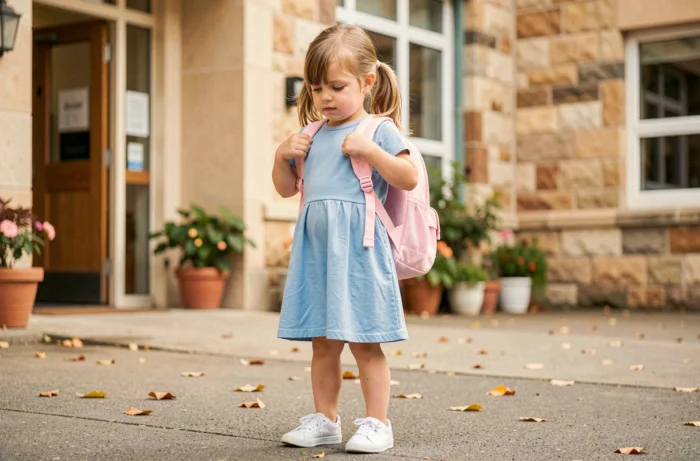
A three-year-old child weighs on average around 14 kg. Their backpack, once filled with a comfort object, a change of clothes, and a snack, should not exceed one and a half kilograms to respect the health guideline of 10% of the child’s weight. This threshold, regularly cited by health professionals and the FCPE, has never been enshrined in French law.
Knowing what to put in a preschool backpack, and what the empty backpack weighs, affects daily comfort much more than the design printed on the flap.
Preschool backpack and posture: an underestimated health issue before age six
Postural disorders related to carrying loads do not start in middle school. Between the ages of three and five, the spine is still maturing, and the trunk muscles do not yet have the necessary tone to compensate for prolonged imbalance. A backpack that is too heavy or poorly positioned pulls the shoulders back and deepens the lumbar lordosis.
The 10% body weight guideline remains the most cited reference in public health recommendations. For a child in the lower section, this leaves a very narrow margin. A rigid backpack with a metal frame can weigh more than 500 grams when empty, which is already a third of the allowed load budget before adding anything to it.
The new health booklet given to parents since January 2025 includes updated recommendations from the High Council of Public Health, with increased attention to monitoring the child’s weight, particularly through the mandatory medical check-up at age six. The issue of the backpack fits into this early prevention logic, even if the document does not explicitly mention the school bag.
To choose a suitable preschool backpack, the first instinct should be to weigh the model empty in the store. A soft bag made of canvas or recycled polyester easily weighs under 300 grams, compared to double that for some structured models.
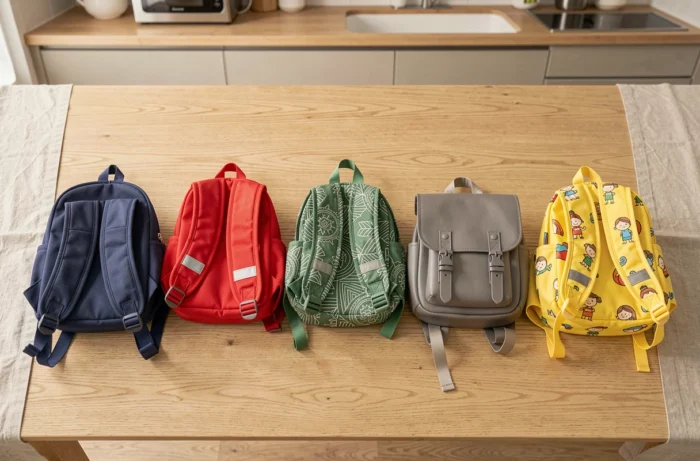
Size of the preschool backpack: what the school really requires
Most guides recommend choosing the size according to the section (small, medium, large). In practice, the decisive criterion is the communication notebook. Some schools use a standard-sized notebook, while others use a small notebook. As long as the backpack accommodates this document, the rest of the contents (tissues, water bottle, spare clothing) do not pose any space issues.
A bag 25 to 30 cm high is sufficient for the small and medium sections. Models of 33 cm, often presented as versatile, are sized to hold a large notebook of type 24 x 32 cm, a format rarely required before the large section.
The width of the backpack should not exceed the child’s shoulders. A bag that is too wide tips to the sides, forces the arms apart, and alters the gait. Before buying, it is better to measure the distance between the child’s two shoulders and compare it with the dimensions of the targeted model.
Soft backpack or flap backpack
The soft backpack, lightweight and easy to handle, is well-suited for the early years. The child can open and close it independently thanks to a zipper. The flap backpack with clip or buckle offers wider access, but some closure systems remain difficult for a three-year-old to manipulate.
Field feedback varies on this point: preschool teachers report that flap backpacks often end up open in the hallway due to insufficient fine motor skills. The backpack with a simple zip poses fewer autonomy problems, even if it organizes the contents less effectively.
Straps, back, and padding: the technical details that change comfort
The straps are the main point of contact between the bag and the child’s body. Three characteristics really matter:
- Wide and padded straps: they distribute the load over a larger surface and limit friction on the collarbones, especially when the child wears a thin t-shirt in summer.
- Adjustable length straps: the bottom of the bag should not drop below the waist. If the backpack hits the buttocks, the straps are too long, and the weight pulls backward.
- Padded back with ventilation: a rigid but padded back panel presses the bag against the back without creating pressure points. Some models incorporate mesh fabric to limit sweating.
A chest strap (sternum clip) prevents the straps from slipping off the narrow shoulders of young children. This detail, common on hiking bags, is starting to appear on preschool backpacks. It significantly improves stability without adding significant weight.
Materials and maintenance: what labels don’t always say
A preschool backpack faces specific challenges: spilled applesauce, a poorly closed water bottle, regular contact with the ground in the playground. Water resistance of the outer fabric is not a luxury; it is a practical necessity.
Polyester remains the dominant material. Some manufacturers offer recycled polyester (made from plastic bottles), with mechanical properties comparable to virgin polyester. A water-repellent fabric prevents the contents of the bag from getting soaked after ten minutes in the rain.
Maintenance is a criterion often overlooked at purchase. A machine-washable backpack at low temperatures simplifies life throughout the school year. Models with rigid elements (reinforced bottom, frame) generally do not withstand machine washing and require hand cleaning.
- Check for a reinforced or waterproof bottom to protect the contents when the bag is placed on the ground.
- Prefer zippers with large teeth, which are more durable and easier for small hands to manipulate.
- Ensure the absence of small detachable pieces (pom-poms, charms) that pose a choking risk in the lower section.
The design and printed characters play a real role in the child’s attachment to their bag, and thus in their desire to use it. The available data do not allow for a conclusion that a pattern influences the product’s durability, but a child who loves their backpack generally takes better care of it.
The best preschool backpack is the one that the child can carry, open, and close independently. Before finalizing a purchase, trying it in-store with the bag weighted down with a notebook and a water bottle provides a much more reliable idea than any online product sheet.