
The average shoe size for men in France is between 42 and 43 according to sources, but this figure masks a more complex reality. Measurement systems vary from country to country, brands do not all apply the same sizing charts, and foot width remains a parameter largely ignored by most buyers. Understanding what a shoe size truly encompasses helps avoid mistakes that affect daily comfort.
Why a 42 doesn’t always correspond to a 42
The European shoe sizing system is based on the Paris point, a unit of measurement dating back to the 19th century. Each point corresponds to two-thirds of a centimeter. In theory, a 42 EU designates the same shoe length across all brands. In practice, the discrepancies between brands often reach half a size, sometimes more.
Several factors explain these variations. The shape of the shoe (the “last”) differs among manufacturers. An Italian brand often runs narrower than an American brand. The type of shoe also plays a role: a sneaker generally has more interior volume than a classic derby, even at the same size.
Conversion charts between EU, UK, and US systems add a layer of confusion. A European 42 sometimes corresponds to an 8 UK, sometimes to an 8.5, depending on the chart used by the manufacturer. To navigate these discrepancies, a size guide on Style Papers details the correspondences by system and shoe type.
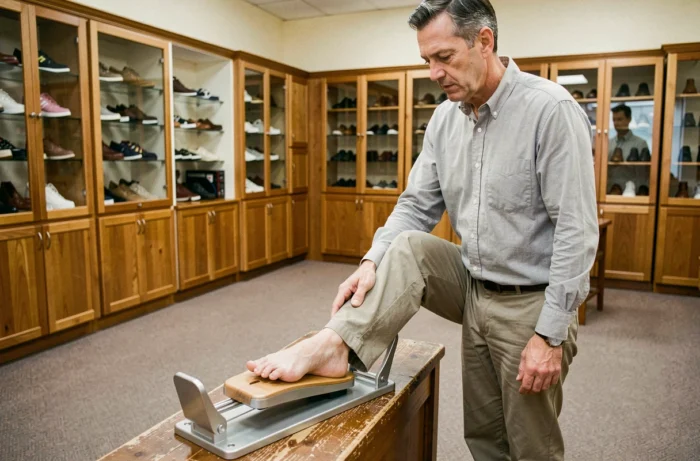
Foot width: the criterion that size alone does not cover
Shoe size only measures length. Two men wearing size 43 can have feet of very different widths. Ignoring this parameter explains a large part of comfort issues: friction, compressed toes, lateral instability.
Foot width is as crucial a selection criterion as length. Some manufacturers, notably New Balance, now offer several widths for the same model: narrow, standard, wide, extra-wide. This approach remains minority in the industry, but it is progressing.
To measure foot width, the method is simple: place the foot flat on a sheet of paper, trace the outline, then measure the distance between the inner edge and the outer edge at the widest point (the base of the toes). This measurement, combined with length, provides a much more reliable picture than size alone.
When width changes the choice of model
A wide foot in a standard shoe will crush the leather on the sides and deform the upper. Conversely, a narrow foot in a model that is too generous will lack support, causing blisters from slipping.
- Wide foot: favor models available in “wide” width or brands known for generous fits (some New Balance lines, for example)
- Narrow foot: opt for shoes with tight lacing or brands with a more fitted last, common among Italian manufacturers
- Standard foot: most models will fit, but checking the fit during trying on remains useful, especially for dress shoes
Measuring your foot correctly before buying online
Online shopping complicates size selection because you can’t try them on. The solution lies in precise measurement, done under the right conditions.
The foot naturally swells throughout the day. Measuring in the late afternoon gives a more realistic result than in the morning. You should also measure both feet: most people have one foot slightly larger than the other, and that one should serve as the reference.
Reliable measuring method
Place the foot on a white sheet of paper, against a wall. Mark the furthest point (usually the big toe or the second toe) with a pencil. Measure the distance between the wall and this mark. This length in centimeters is then referenced against the brand’s specific chart, not a generic one.
Each brand publishes its own sizing chart, and that is the one to consult. A “universal” chart found on a third-party site can be misleading, precisely because the charts vary from one manufacturer to another.

Shoe size and type: adjustments to consider
The ideal size is not always the same depending on the type of shoe. For a pair of running shoes, specialists recommend taking half a size larger than your usual size. The foot moves forward in the shoe with each stride, and insufficient space in front of the toes can cause black toenails or pain.
For dress shoes (derbies, oxfords), the fit should be more snug. Leather stretches with wear, and a shoe that is too large initially will only widen further. Quality leather stretches about half a size in width after a few weeks of use.
- Sneakers and athletic shoes: take your usual size, or even half a size up if the model runs small (check reviews)
- Running shoes: always plan for an additional half size compared to foot measurement
- Leather dress shoes: take your exact size and rely on the natural stretching of the leather
- Boots and ankle boots: test with the socks you will actually wear, often thicker than in summer
Traceability of shoes sold online in the EU
The European regulation 2023/988 (known as GPSR) applies from December 13, 2024. It requires online shoe sellers to enhance safety information, traceability, and product identification on their listings. This framework does not create a specific logo: it demands precise data on the manufacturer, importer, and product characteristics.
For the consumer, this means that a complete product listing (with clear identification of the manufacturer and traceability information) is now an indicator of compliance. Conversely, the absence of these mentions on a sales site may signal a seller who does not comply with current regulations.
The average male shoe size remains a useful statistical benchmark for manufacturers, but it has limited value for individual purchases. What determines the comfort of a shoe is the combination of the measured length of the foot, its width, the type of shoe intended, and the specific sizing chart of the brand. Four parameters that the mere mention of “size 42” does not summarize.