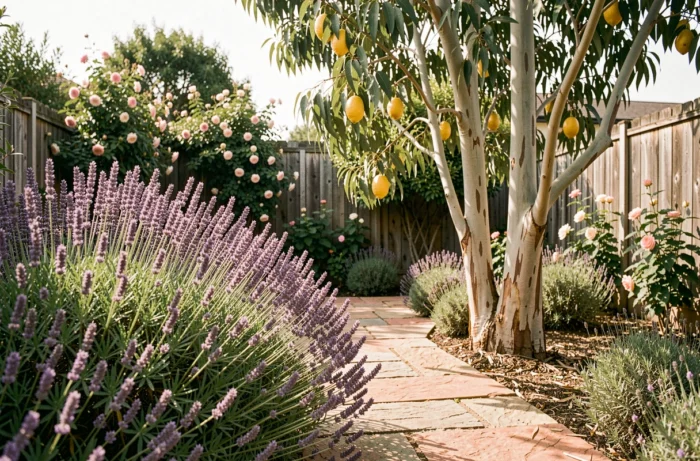
Some plants release volatile organic compounds that disrupt the olfactory system of mosquitoes. These molecules, primarily terpenes and aldehydes, blur the chemical signals (CO2, lactic acid) that insects use to locate their targets. Planting trees or shrubs that produce these substances can reduce mosquito pressure in a given area, provided one understands how this repulsion actually works and where to place these plants.
Actual Range of Repellent Plants: What Foliage Emits (and What It Doesn’t)
The most widespread misunderstanding concerns the range of the repellent effect. A shrub placed at the back of the garden does not create an invisible shield over the entire plot. Volatile compounds only act at very short distances, within a radius of a few dozen centimeters around the foliage.
The emission of these molecules significantly increases when the leaves are crushed or rubbed. An intact lemongrass or catnip plant releases far fewer active substances than manipulated foliage. This means that a decorative bed planted to “look nice” will have a negligible effect if no one interacts with it.
By studying the most documented mosquito-repellent trees and shrubs, it is observed that their effectiveness depends less on the chosen species than on how they are arranged and maintained.
Barrier Planting: Placement Matters More Than Species

Recent content on the subject emphasizes a simple principle: align pots or plants in a barrier near passage areas rather than dispersing them throughout the garden. Specifically, this means bordering the terrace, framing the entrance to the house, or lining the path leading to the outdoor table.
This logic of “olfactory curtain” works because the concentration of volatile compounds remains localized. Three or four pots grouped near a garden table produce a more noticeable effect than a single isolated shrub, even if the latter is larger.
Combining Multiple Species in the Same Line
Combining shrubs with different olfactory profiles further blurs signals for mosquitoes. A lavender plant next to a rosemary plant and a pot of small-leaved basil creates a more complex terpene cocktail than a single species in monoculture.
This approach also has a practical advantage: if one species suffers from overly calcareous soil or excess water, the others take over in the barrier.
Repellent Trees and Shrubs: Three Profiles to Favor in the Garden
Rather than a catalog of ten species, let’s focus on three plant profiles whose mode of action differs.
Lemon Eucalyptus, a Widely Distributed Tree
Lemon eucalyptus (Corymbia citriodora) produces citronellal, an aldehyde found in many mosquito repellent formulations. Its foliage emits a strong lemon scent, even without manipulation. In a mild climate, it can reach a significant size and cover a larger area than a simple shrub.
Its limitation: it does not tolerate prolonged frost well. Outside the Mediterranean perimeter or the southern Atlantic coast, growing it in a large pot is preferable so it can be brought indoors in winter.
Osmanthus, a Discreet but Persistent Shrub
Osmanthus produces a fragrant bloom reminiscent of jasmine in spring and autumn. This scent, pleasant to us, disrupts the olfactory receptors of mosquitoes. Osmanthus adapts to most soils and withstands repeated pruning, allowing it to be shaped into a dense hedge along a terrace.
Its interest lies in its persistence: the foliage remains in place all year round, unlike aromatic plants that disappear in winter.
Catnip (Nepeta cataria), the Underestimated Profile
Catnip, or catmint, is making a strong comeback in recent recommendations. The nepetalactone it contains is a powerful repellent against several species of mosquitoes. The plant forms a small bushy shrub that blooms in summer, precisely when mosquito pressure peaks.
Be cautious if you have cats: the plant irresistibly attracts them, which can pose a problem in well-maintained beds.
Anti-Mosquito Geranium: An Effect Primarily Decorative
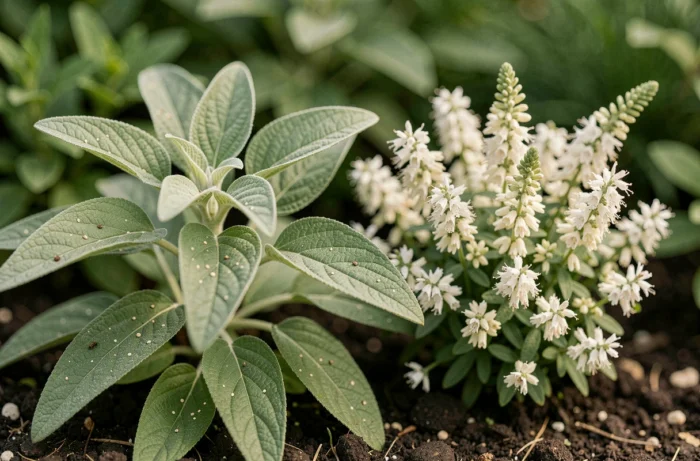
Scented geranium (Pelargonium graveolens or citrosum) is probably the most sold plant under the “anti-mosquito” label. Its reputation is based on the presence of geraniol and citronellol in its leaves.
In practice, the repellent effect of potted geraniums is limited to a very small perimeter. Several recent reports qualify commercial promises: placed on a windowsill or at the end of a terrace, it is not enough to protect a dining area. Its main asset is aesthetic, and it usefully complements a plant barrier without constituting its pillar.
Precautions and Practical Limits to Know
Before composing your anti-mosquito hedge, a few constraints deserve to be clearly stated:
- Lantana, sometimes cited as a repellent, has toxicity for pets (dogs, cats, rabbits). Its use in a family garden requires particular vigilance.
- No plant can replace the removal of stagnant water. A forgotten saucer under a pot, a bucket left outside, or a clogged gutter is enough to produce hundreds of larvae in a few days.
- Evergreen shrubs (osmanthus, laurel) provide year-round coverage, while aromatic plants (basil, mint, lemon balm) disappear or slow down significantly in winter. Alternating the two types ensures continuous plant presence.
- In humid or clay soils, prefer elevated pot cultivation for Mediterranean species (lavender, rosemary) that fear excess water at the root level.
The most reliable strategy combines three actions: eliminating stagnant water points, placing repellent plants in a tight line near living areas, and regularly crushing the foliage in the evening when mosquitoes are active. A well-thought-out garden along these three axes significantly reduces nuisances, without chemical products or electrical gadgets.