The Hauts-de-France Polytechnic University provides its students and staff with a set of digital services accessible from a single portal. The UPHF ENT centralizes messaging, courses, schedules, and collaborative tools. Behind this familiar facade, several software components remain underutilized due to a lack of clear identification by users.
Collaborative tools integrated into the UPHF ENT: beyond Moodle
Most guides on the ENT focus on logging in and checking the schedule. The collaborative tools surrounding Moodle deserve closer examination.
The ENT provides centralized access to several distinct components. Moodle hosts course materials, assignment submissions, and quizzes, with several thousand active course spaces. The POD video platform aggregates a substantial catalog of educational videos. FileSender allows the transfer of large files without going through third-party services. Rocket.Chat offers an integrated group discussion space within the university ecosystem.
These tools have been around for some time, but their grouping under the same authentication portal simplifies navigation. A student who still uses WeTransfer or WhatsApp to exchange course documents misses out on solutions already included in their institutional access. To access Emploi Plus services and view a detailed overview of these resources, the approach remains complementary to the direct exploration of the portal.
Push notifications and the MonUPHF app: how mobile access changes things
Access to institutional messaging, Moodle courses, and videoconferencing tools works equally well via the browser or the mobile app. Push notifications on MonUPHF change daily responsiveness: a message from a teacher, a schedule change, or a reminder for assignment submission arrives directly on the phone.
This shift to mobile is not trivial. It raises the question of the boundary between student life and personal life. Receiving a course notification at 10 PM on a Sunday night carries a different weight than an email checked on Monday morning at a desktop computer.
Notification settings
The app is supposed to allow filtering of the types of alerts received. Feedback from the field varies on this point: some students report that fine-tuning settings is not always intuitive, and that disabling one category of notification can inadvertently hide others. Regularly checking notification preferences helps avoid missing information about a room change or an exam rescheduling.
Digital educational resources from UPHF: beyond the lecture
UPHF provides access to resources produced internally and by other higher education institutions. These contents come from various databases, including Thematic Digital Universities (UNT).
The databases queried cover broad areas:
- AUNEGE for economics and management, Unisciel and UEL for fundamental sciences, UNIT for engineering sciences
- UOH for humanities, social sciences, literature, languages, and arts, UVED for environment and sustainable development
- Canal-U, the digital video library of higher education, which offers lectures and filmed courses available for free access
The majority of these documents are freely accessible. Some content may be restricted based on the rights set by the author or the producing institution. A management undergraduate seeking additional case studies would benefit from exploring AUNEGE before turning to paid platforms.
Account security and SESAME activation: a recurring friction point
Personalized access to the ENT relies on single sign-on authentication. Account activation goes through the SESAME system, which generates credentials based on the information on the student ID card. Without this preliminary step, no online service is accessible.
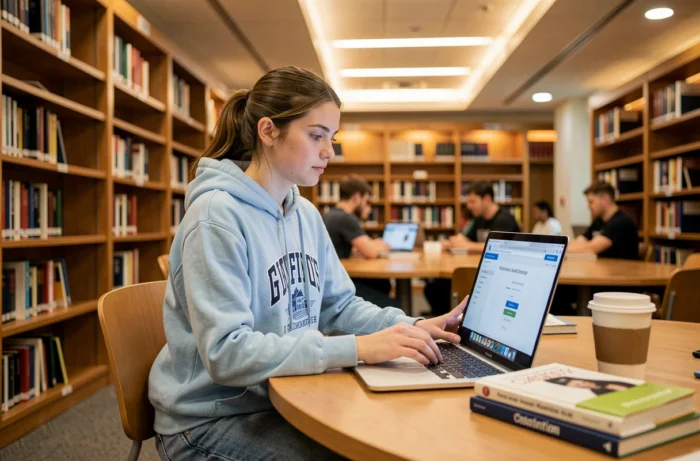
A detail often overlooked: after each session on a shared computer (university library, open-access room), manual logout is necessary. The ENT does not automatically log out after a short period. A person using the same computer right after could inadvertently find themselves logged into the previous account.
Equipment lending and open-access rooms
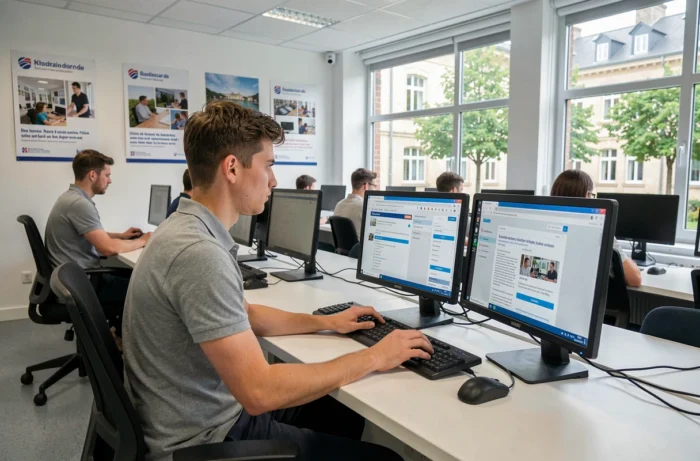
Laptops are available for loan at the Mont Houy and Tertiales university libraries, for use within the premises. Open-access computer rooms complement the setup. Inquiring with one’s department helps identify available time slots, as attendance varies greatly depending on the time of the academic year.
All of these services form a coherent ecosystem, provided one knows the different layers. The UPHF ENT is not just a portal for passive consultation: it is a complete work environment whose effectiveness depends on the time invested in exploring its less visible features.