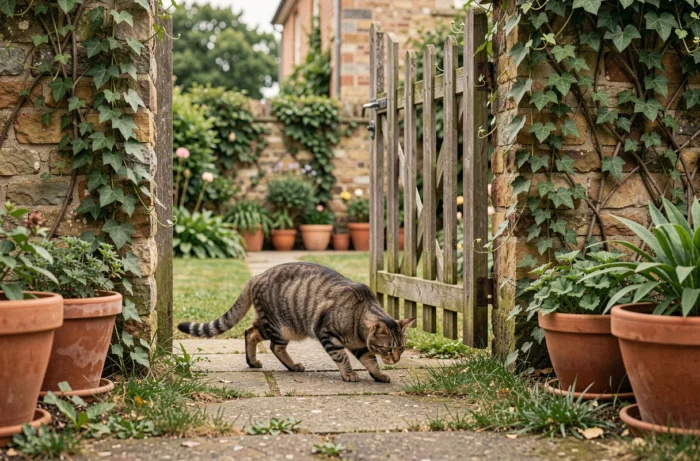
A cat you have never seen pushes open the door to your garden, settles on your terrace, or meows in front of your window. This situation is common in France, where the domestic feline population is among the largest in Europe. Behind this behavior lie territorial, nutritional, and social mechanisms that deserve to be examined on a case-by-case basis.
Unknown cat at your home: what French law says about wandering
Even before seeking a behavioral explanation, the regular presence of an unknown cat at your home raises a legal question. Under French law, a domestic animal found far from its home can be classified as an animal wandering, which engages the responsibility of its owner.
An unidentified cat (without a microchip or tattoo) is considered to be wandering as soon as it is more than 200 meters from homes or more than 1,000 meters from its home. An identified cat benefits from a slightly wider range, up to 1 km, before wandering is characterized. Beyond that, the owner risks fixed fines, especially in cases of repeated complaints for neighborhood disturbances.
This framework changes the interpretation of the situation. If a cat returns to your home every day, it is possible that its owner is unaware of the legal implications of these escapades. Trying to understand the visit of an unknown cat also involves this legal dimension, often absent from discussions between neighbors.
Feline territory and food resources: the two drivers of a visit
The domestic cat retains a territorial behavior inherited from its wild ancestors. Its territory does not correspond to the boundaries of its owner’s property. It divides it into hunting, resting, and passage zones, sometimes spread over several hundred meters.
Your home as an extension of the territory
A cat methodically explores its environment. When it spots a quiet garden, a shelter under an awning, or an accessible water source, it incorporates it into its mental map. Your home is not “chosen” out of spontaneous affection: it meets a functional need in the cat’s territorial network.
Unneutered cats significantly expand their exploration perimeter, especially during breeding season. An intact male can travel distances far exceeding its usual range, which explains the sudden appearances of cats never seen before.
The issue of food left outside
A bowl of kibble on a terrace acts as a powerful signal. Cats identify reliable food sources and return to them with remarkable regularity. Feeding a stray cat, even out of compassion, can pose a concrete problem: an accessible bowl attracts several cats and permanently alters the passage routes in the neighborhood.
In France, feeding stray cats under certain conditions can even expose one to a fine, particularly in cases of municipal orders prohibiting feeding in public spaces or in the common areas of a building.
Visitor cat behavior: distinguishing a lost animal from an explorer
Not all cats that show up at your home are in the same situation. Knowing how to read their physical condition and behavior allows for an appropriate response.
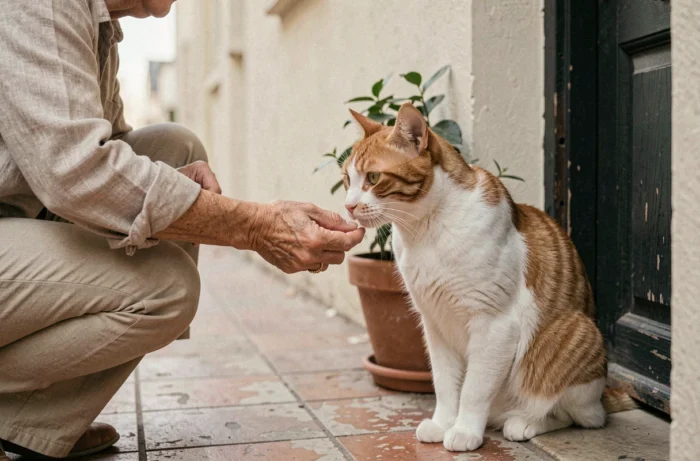
- A cat with a well-groomed coat, well-fed, that rubs against your legs without fear, is likely a domesticated animal expanding its territory. It has an owner and goes home.
- A thin cat with a dull coat, eye discharge, or visible injuries may be a stray or abandoned animal. Its situation calls for intervention.
- A fearful cat that keeps its distance, runs away at the slightest movement but returns regularly to eat, exhibits typical behavior of a feral cat (returned to a semi-wild state).
The presence of a collar or a visible tattoo (in the ear or inside the thigh) immediately indicates an identified animal. In the absence of external signs, only a veterinarian can check for the presence of a microchip.

Identity verification and concrete steps in the face of an unknown cat
Identification is the pivot of any decision. An identified cat by microchip or tattoo has an owner registered in the national I-CAD file. A veterinarian, an equipped pharmacy, or a shelter can read the microchip for free.
If the cat is not identified, several steps can clarify the situation:
- Contact the town hall of your municipality, which keeps a register of lost declarations and reports of stray animals.
- Post a photo and description on local social media groups dedicated to lost animals.
- Notify local animal protection associations, which often manage sterilization and capture campaigns (TNR protocol: trap, neuter, return).
- File a report with the municipal pound, the only entity legally authorized to collect a wandering animal.
Keeping a found cat without taking these steps for a reasonable period could be considered appropriation. The civil code provides for a holding period before any adoption, varying depending on whether the animal is identified or not.
Should you encourage or discourage visits from a foreign cat?
The answer depends on your situation. If you already have a cat, welcoming a regular visitor may trigger territorial stress in your resident animal: urine marking, loss of appetite, unusual aggression. Field reports vary on this point, with some cats cohabiting without visible tension while others develop lasting behavioral issues.
To discourage a cat without harming it, a few measures work: remove any external food sources, close access to shelters (garage, shed), use natural repellents based on citrus or white vinegar at entry points. Ultrasonic devices sold in garden centers yield variable results depending on the individuals.
An unknown cat that keeps returning, in good health and visibly socialized, is likely a neighbor’s wandering pet. In this case, a direct exchange with the neighbors often suffices to identify the owner and adjust everyone’s habits. The problem is rarely resolved by constraint, and almost always through understanding the territorial functioning of the cat.