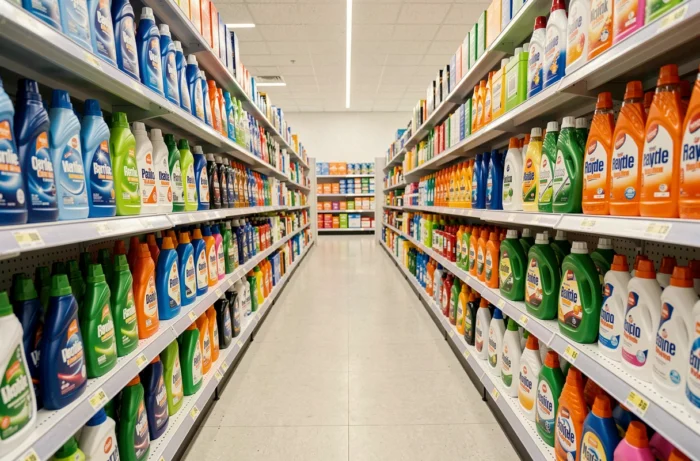
Domestos, a bleach-based cleaning gel manufactured by Unilever, is becoming increasingly rare on the shelves of French supermarkets. The recurring stock shortages are not simply due to a one-off logistical issue. They are part of a broader reconfiguration of the household cleaning market, involving reformulation of product lines, regulatory pressure on biocides, and the rise of almost professional-grade products aimed at consumers.
Reformulation of the Domestos range and its impact on availability
Since 2025, Unilever has been steering Domestos towards a so-called eco-modernization trajectory. New packaging, reformulated formulas, and reorganized distribution channels: this industrial transition is mechanically causing gaps on the shelves.
Distributors must simultaneously manage the clearance of old formats and the listing of new references. During this transition phase, some retailers find themselves out of stock for several weeks. This phenomenon is exacerbated by the approval delays for new biocide product formulas in Europe.
For consumers faced with this situation, the question arises of where to find Domestos or its alternatives without losing disinfecting effectiveness. The answer depends on the type of surface to be treated and the level of disinfection required.
Pro-sumer disinfectants: the segment replacing Domestos on the shelves
The rise of almost professional-grade disinfectants sold to consumers is reshaping the market. This segment, referred to as “pro-sumer” in industry reports, already accounts for a significant share of the revenue from consumer-grade professional cleaners.
Europe represents about 27.8% of this market, with an expected annual growth rate of around 11.9% until 2034. In practical terms, consumers who can no longer find Domestos are not settling for an inferior product. They often migrate towards more concentrated cleaners sold in drugstores or online, with dosages and instructions similar to those used in restaurants or institutions.
What this changes in choosing an alternative
A typical supermarket bleach gel generally contains sodium hypochlorite at a moderate concentration. Pro-sumer products display higher concentrations and broader biocidal spectra. The gain in effectiveness comes with increased handling requirements: gloves, ventilation, strict adherence to contact times.
For everyday use (toilets, bathrooms, kitchen surfaces), this over-power remains debatable. The choice depends on the context: a household with a septic tank does not have the same constraints as an apartment connected to a public sewage system.
Septic tank compatibility: the criterion many overlook
Bleach-based cleaners, including Domestos, pose a well-documented problem for non-collective sanitation systems. Sodium hypochlorite destroys the bacteria that ensure the digestion of materials in the septic tank.
Alternatives compatible with a septic tank rely on different active ingredients:
- Lactic acid or citric acid, present in several eco-friendly household cleaners, provide a moderate descaling and antibacterial action without harming the bacterial flora of the tank.
- Soda-based products (such as alkaline floor or multi-purpose cleaners) offer good degreasing power, but their high pH requires careful dosing to avoid disrupting the biological balance.
- Enzymatic cleaners, initially designed for professional maintenance, are now becoming available in the consumer market. They break down organic residues without a biocidal effect on the tank.
The mention of “septic tank compatible” on the packaging is not subject to any official harmonized certification in France. Checking the list of active ingredients is more reliable than relying solely on marketing labeling.
Biocide regulation in Europe and its impact on household cleaners
The European regulation on biocidal products (RPB) imposes an authorization procedure for any active substance claiming a disinfecting effect. Manufacturers of household cleaners must submit approval files, the processing of which takes several years.
This regulatory constraint has a concrete effect on the shelves. Some formulations disappear due to a lack of timely renewal. Others are preemptively withdrawn by manufacturers who anticipate a refusal or prefer to concentrate their resources on newer formulas.
What this means for consumers
A cleaner marketed as “disinfectant” in 2023 may very well no longer carry that designation two years later, without any change in its composition. The difference lies in the regulatory status, not in the actual effectiveness of the product. Field feedback varies on this point: some cleaning professionals believe that losing official biocide status does not affect performance in domestic conditions, while others emphasize the importance of standardized validation.
Bleach-based products remain authorized, with sodium hypochlorite listed among the approved active substances. However, products combining bleach and specific surfactants may see their status evolve on a case-by-case basis.
Choosing an alternative to Domestos: concrete criteria
Rather than listing brands, it is more useful to identify selection criteria that allow for objective comparison:
- The concentration of active substance: a gel with 2.6% sodium hypochlorite does not have the same power as a product with 4.8%. The safety data sheet (SDS), available online for most products, provides this information.
- The pH and type of acid or base: determines compatibility with surfaces (enamel, stainless steel, plastic) and with the sanitation system.
- The claimed contact time: a product that requires 15 minutes of contact for bactericidal action is not as practical as a spray that works in 30 seconds.
- The galenic form: gel, spray, liquid. The gel adheres better to the walls of toilets and bathrooms, extending the contact time without intervention.
The shortage of Domestos has at least one merit: it encourages consumers to read labels instead of repurchasing out of habit. Dosage, compatibility with the wastewater system, and concentration of active substance remain the three criteria to check before any purchase.