
A colleague who shows up on a Monday morning with a shaved head, a clipper left on the zero setting after a botched cut, a fade that no longer hides anything: situations that lead one to consider a full shave are rarely glamorous. Before pulling out the blade, one can check a few concrete points to avoid regret on Tuesday morning. A shaved head does not forgive approximations, but it rewards those who assess their morphology and routine.
Test the shaved head without taking out the razor
The most reliable method remains to run the clipper without a guard over the entire scalp. You get a cut to a few millimeters that gives a realistic preview of the head’s volume, contours, and any scars. This intermediate stage allows you to live with a very short look for two or three weeks before deciding whether to go down to the razor.
For those hesitant to cut anything, salons offer “fake shaved head” prosthetics that simulate the final result. You put on a kind of smooth hair helmet, look at yourself under different lighting, and observe the reactions of those around you. Feedback varies on this point: some find the simulation convincing, while others believe that nothing replaces the real act.
Tricopigmentation offers another avenue. This hair tattoo mimics very short regrowth and gives the illusion of a freshly shaved head. Specialized institutes present it as a way to test the “shaved” aesthetic without a definitive commitment, particularly to assess the proportions of the face from all angles. To delve deeper into the process and understand how to know if a shaved head suits you, several morphological criteria deserve attention.
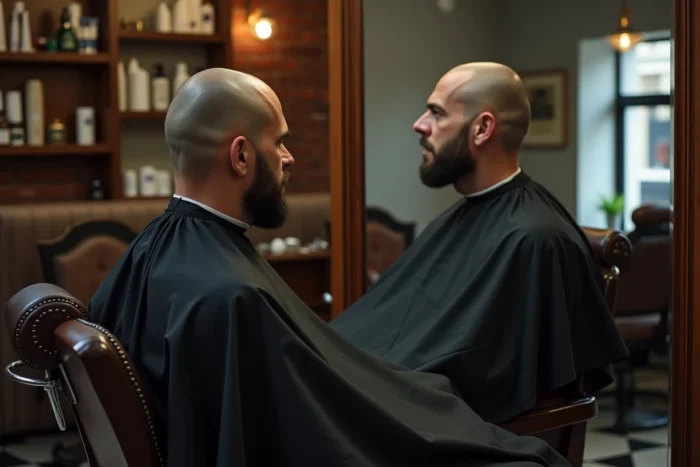
Head shape and facial proportions: concrete markers
The shape of the head is often talked about as the decisive criterion. In practice, three specific areas are checked.
The back of the head
Run your hand from the nape to the top. A relatively rounded head at the back gives a balanced profile once shaved. A very flat surface or a pronounced bump will be noticeable, but the beard and glasses redirect attention to the face, which mitigates the impact of an imperfect back.
The top and temples
A slightly rounded top looks better than a very elongated head, which can accentuate an impression of disproportionate height. Hollow temples, on the other hand, are more noticeable without hair. You can spot them by slicking wet hair against the scalp under direct light.
The jaw and chin
Without hair, the lower part of the face carries more visual weight. An angular jaw or a well-defined chin naturally balances the volume lost at the top. For rounder faces or receding chins, a short beard restructures the facial silhouette and compensates for the lack of contrast.
Markers to check before shaving:
- Run your hand over the back of the head to detect bumps, hollows, or unusual flat areas
- Slick wet hair under harsh lighting (bathroom, neon lights) to simulate the shaved effect on the top and temples
- Observe the face without visible hair (swim cap, wide headband) to assess jaw-forehead balance
- Take a strict profile photo, not just a front view, as the profile reveals asymmetries
Skin color and scalp: what you discover after shaving
Shaving exposes the scalp to direct light, and the difference in tone between the tanned face and the top of the head protected by hair surprises almost everyone in the first few days. On light skin, the contrast can be pronounced. It fades over a few weeks of gradual exposure, provided the area is protected with suitable care or a head covering initially.
Moles, scars, and pigmented spots become visible. Before shaving, it is useful to have your scalp examined by a dermatologist if you have never done so. Some lesions go unnoticed under hair for years.
The texture of the scalp also plays a role in daily comfort. Oily skin will require frequent cleansing to avoid a shiny appearance. Dry skin will need a light moisturizer after each shave to limit tightness and flaking.

Maintaining a shaved head with a razor: the realistic routine
Many imagine that a shaved head simplifies life. In reality, shaving every two to three days maintains a clean result. Letting more time pass gives a “neglected regrowth” look that has nothing to do with the desired appearance.
The equipment makes a difference. A multi-blade razor or a safety razor provides a smoother result than a clipper without a guard. Apply shaving cream or gel on the damp scalp, shave in the direction of hair growth for the first pass, then across to refine. The against-the-grain pass is tempting but often causes irritation on the top of the head.
The maintenance sequence that works:
- Warm shower to open pores and soften regrowth
- Application of shaving gel or cream (no dry foam, too little glide)
- Shaving with a clean razor, in short passes and without excessive pressure
- Rinsing with lukewarm water followed by applying an alcohol-free moisturizing care
- Sun protection on the scalp as soon as you go out, even on cloudy days
A shaved head is not a fixed look. The beard, accessories (glasses, earrings), and even tanning significantly change the overall effect. The overall style matters as much as the shape of the head. Rather than seeking the perfect morphology, one adjusts the elements around: a three-day beard, bold frames, or a turtleneck change the game more than an extra millimeter of roundness in the head.